Have you ever thought about how Ayurveda explains the world, health, and life? The Pancha Mahabhutas is the most important idea in Ayurvedic medicine. Ayurveda says that these elements make up everything in the universe.
These elements are space (Akash), air (Vayu), fire (Agni), water (Jala), and earth (Prithvi). These are not things that are real. They are natural forces and traits that affect how everything works. In living things, these elements combine with Atma (the soul) to build life.
Ayurveda uses the Pancha Mahabhutas to explain:
- How the body works
- How diseases form
- How medicines react in the body
So, every bite of food, herb, and drug contains all five elements. The dominant element decides its effect. Ayurveda classifies substances as dominant on earth, water, fire, air, and space. Now, these are substances; the same logic applies to human beings, too.
Ayurveda explains body types through tridoshas. Vata, Pitta, and Kapha arise from these five elements. These three types of doshas control all physical and mental functions.
In this article, we explore the five elements of Ayurvedic healing. Understanding the types of doshas and these elements will help you know your own body.
What are the 5 Elements of Nature in the Human Body?
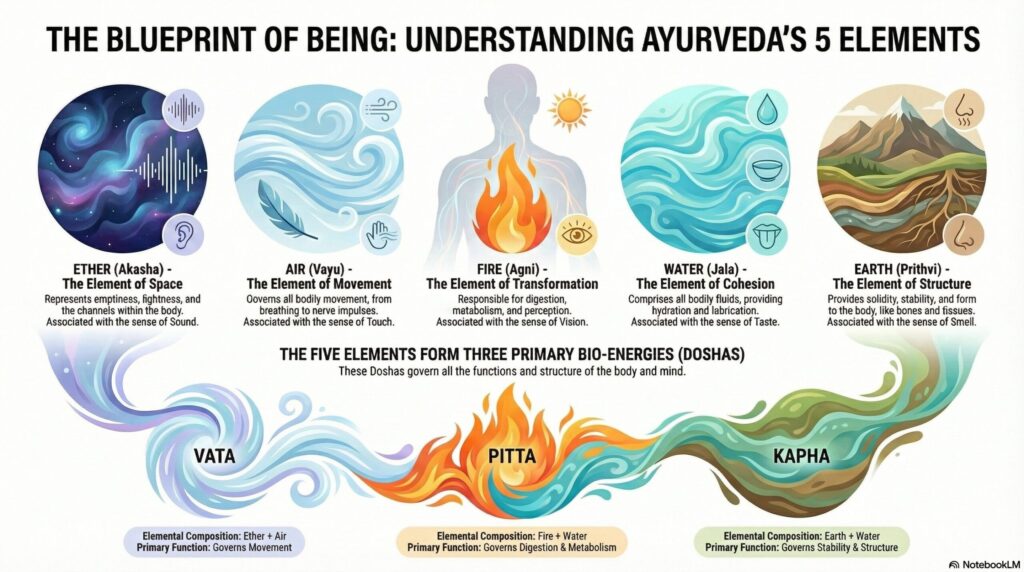
Ayurveda considers these five elements as basic building blocks called Pancha Mahabhutas. Each element has its own characteristics, qualities, senses, and role in the body. Together, they control structure, movement, digestion, fluids, and awareness.
Space (Ether/Akasha)
Ether, or space, doesn’t mean sky. It means openness and emptiness. It gives space for everything to exist and move.
- It creates all empathy spaces in the body. Like the mouth, nostrils, lungs, stomach, intestines, blood vessels, and more. It also comprises the spaces around cells in the body.
- It allows the sound to travel and connects to the sense of hearing.
- This element is open and non-resistant. It forms the base for other elements.
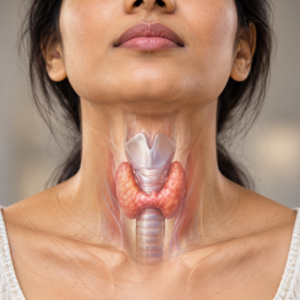
- Ether connects to the throat chakra (Vishuddha). The connection supports communication and expression. It is clear that without space, movement is impossible.
Air (Vayu)
The balanced air element makes the body feel light and active. Air also creates movement.
- It controls breathing, muscle movement, nerve signals, circulation, and nutrient transportation.
- It governs movement inside joints and the digestive tract.
- Air connects to the sense of touch through the skin.
- Its quality is movement and dryness.
- Air connects to the heart chakra (Anahata).
- This is the main element of the Vata dosha. It monitors body motion and communication.
Fire (Agni or Teja)
Agni, or fire, is a very important Ayurvedic element in the body. Fire arises from moving air and brings about transformation. Also, it turns food into energy. In fact, Ayurveda builds its treatments around keeping this fire balanced. When fire weakens or increases, diseases begin.
- Agni controls digestion, metabolism, body heat, and intelligence.
- There are five specialized forms:
- Sadhak Agni (Intellect)
- Alochaka Agni (Vision)
- Pachaka Agni (Digestion)
- Ranjaka Agni (Blood coloration)
- Bhrajaka Agni (Skin health)
- It converts nutrients into forms that the body can use.
- It powers all cellular activities.
- Fire connects the sense of sight and the eyes.
- It links to the solar plexus chakra (Manipura).
- It forms the central element of Pitta dosha. Pitta dosha manages digestion and energy.
Water (Jala or Apas)
It is a universal fact that the human body contains about 70% water. Water represents flow and connection. In simple terms, it keeps things together. Aapya Dravya, or water, has the following qualities:
Drava (liquidity), Snigdha (oiliness), Sheeta (cold), Guru (heavy), Manda (slow), Mrudu (soft), Pichchila (slimy, sticky), Sara (flow), and Saandra (dense).
- It forms blood, lymph, saliva, digestive juices, and reproductive fluids.
- Water carries nutrients, removes waste, cools the body’s fire, and supports immunity.
- It connects to the sense of taste through the tongue.
- Jala’s main quality is liquidity and softness.
- It links to the sacral chakra (Svadhisthana).
- Water forms a significant part of the Kapha dosha. It provides stability and lubrication.
Earth (Prithvi)
Earth brings stability, strength, and shape to the body. Also, it is the densest element of all.
- It forms bones, teeth, muscles, tissues, skin, hair, and nails.
- It gives endurance and firmness.
- Earth connects to the sense of smell through the nose.
- Its main quality is heaviness and roughness.
- Earth links to the root chakra (Muladhara)
- Also, it supports Kapha dosha, which gives structure.
Substances predominant in Parthiva Dravya have the following qualities like –
Guru (Heaviness), Kathina (Hard), Vishada (Clear), Manda (Slow), Saandra (Dense), Sthula (Fat), Sthira (Stable), and Gandha Guna Bahulya (Predominance of smell sensation).
How the Five Elements Work Together
Every substance contains all five elements. However, one element always dominates and decides its nature. So, in a cell:
- Earth gives the cell structure
- Water fills the cytoplasm
- Fire drives metabolism
- Air enables gas exchange
- Space allows movement in and out
So, Ayurveda uses this knowledge to understand body type, disease formation, and healing. Balance in these elements supports health. When they fall out of balance, body and mind suffer.
The Six Tastes and The Five Elements in Ayurveda
Ayurveda explains taste in a simple way. Every food has a specific taste. Every taste comes from a mix of the five elements. The role of these tastes is more than a pleasure. They affect digestion, energy, and balance in the body.
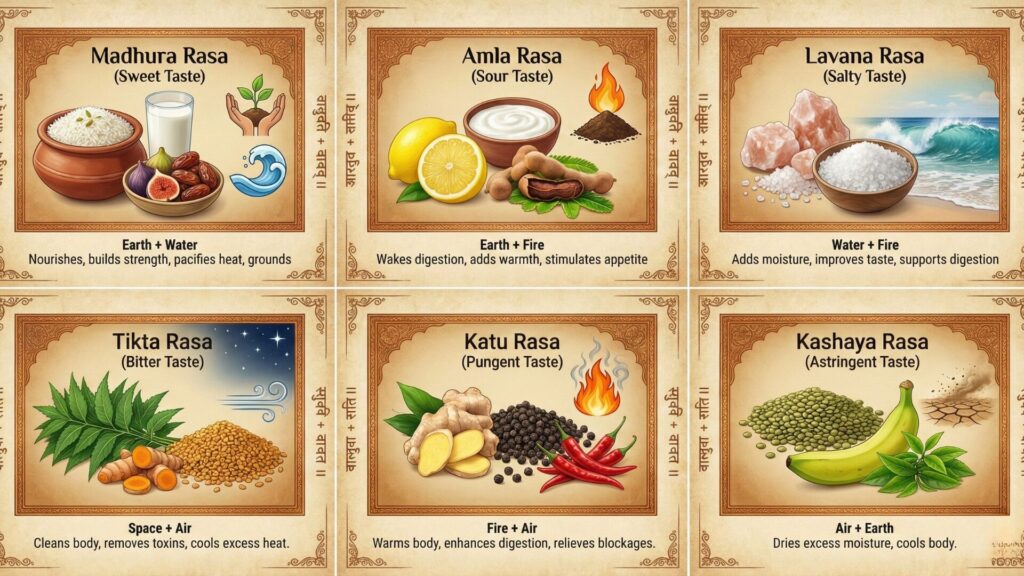
- Madhura Rasa: Sweet Taste = Earth + Water. It nourishes the body, builds strength, pacifies heat, and keeps us grounded. Foods like rice, milk, and fruits have this taste.
- Amla Rasa: Sour Taste = Earth + Fire. This taste wakes up digestion, adds warmth, and stimulates appetite. Lemon, curd, and tamarind belong to this group.
- Lavana Rasa: Salty Taste = Water and Fire. It adds moisture, improves taste, and supports digestion. Natural salt is the best example.
- Tikta Rasa: Bitter Taste = Space + Air. It cleans the body, removes toxins, and cools excess heat. Many herbs and leafy greens taste bitter.
- Katu Rasa: Pungent Taste = Fire + Air. It warms the body, enhances digestion, and relieves blockages. Ginger, pepper, and chillies have this note.
- Kashaya Rasa: Astringent Taste = Air + Earth. It dries excess moisture in the body. It cools the body, too. Lentils, raw bananas, and tea feel astringent.
Note: Consuming all tastes in the right amount supports health. Too much or too little of any taste can disturb the harmony in mind and body.
The Relation between Panchamahabhuta and Tridosha
The research article titled “The Tridosha Concept: A Comprehensive Study from the Perspective of Modern Science” was published in the Journal of Ayurveda and Holistic Medicine (JAHM).
According to Ayurveda, there is a relationship between the Tridosha and the Panchamahabhutas. It explains human physiology and health.
The three doshas are the core of Ayurvedic principles, grounded in the Panchamahabhuta. The Tridosha Siddhanta says that all the body functions depend on Vata, Pitta, and Kapha. These doshas come from the combination of these five elements.

| Vata | Space and Air |
| Pitta | Fire and Water |
| Kapha | Water and Earth |
These doshas work as the body’s driving forces. Together they handle:
- Chalana (Movement)
- Poshana (Nourishment)
- Dharana (Support & Stability)
Each dosha plays a clear role within, from a single cell to the entire body.
A) Vata: It controls movement. It manages breathing, nerve signals, and circulation.
B) Pitta: It controls change and transformation. Pitta governs digestion, metabolism, and heat.
C) Kapha: It strengthens and protects. Kapha builds tissues, immunity, and structure.
These doshas work like the natural forces. It uses the elements of sun, water, and air to support life. Also, the body stays healthy when all three doshas are in balance. Ayurveda calls an imbalance in the doshas “Dosha Vaishamya.” If one or more doshas become imbalanced, disease begins.
Want to know which type of Dosha you are? Click on the photo below to take the Dosha quiz.