Lord Dhanvantari holds a special place in Hindu tradition as the physician of the Devas. Today, people worship him as the God of Medicine and Ayurveda. He is renowned for his ability to heal the gods and protect life from illness. Hindu texts describe Dhanvantri as a partial avatar of Lord Vishnu. Furthermore, his presence, linked with healing, balance, and long life.
Ayurveda refers to Dhanvantari as the father and spiritual source of this healing system. According to the sages, he revealed this medicine to help humanity live the right way. Ayurveda, meaning “Science of Life,” treats illness at its roots. It also guides people towards mental, physical, and spiritual well-being, teaching them how to live in harmony with nature.
Ancient texts like the Charaka Samhita describe Ayurveda as evergreen and generational. The divine passes the Ayurvedic wisdom again and again. Even today, people remember Lord Dhanvantari as a symbol of hope. They believe praying to him will remove suffering and disease. Through him, Ayurveda continues to spread and help people toward health.
How Did Lord Dhanvantari Appear During the Samudra Manthan?
Hindu scriptures say Lord Dhanvantari first appeared during the Samudra Manthan. The churning of the cosmic milk ocean. The same story appears in the Puranas, Ramayana, and Srimad Bhagavatam.
The devas lost their strength after a curse from Sae Durvasa. They wanted immortality and renewed energy. Further, they joined hands with the asuras to churn the ocean. They used Mount Mandara as the churning rod. Also, they used the serpent Vasuki as the rope. Finally, this churning brought out many divine treasures.
Suddenly, Goddess Lakshmi appeared from the ocean, and the Kalpavriksha also emerged. (The Kalpavriksha known as the wish-fulfilling tree.) The final and most important appearance was Lord Dhanvantri.
Then, Dhanvantri rose from the ocean holding a Kalasha of Amrita. Amrita, meaning the nectar of immortality. He appeared young, strong, and radiant.
When viewed, Lord Dhanvantari wore yellow clothing and shining ornaments. He carried four symbols in his hands. They were the Amrita pot, the conch, the Sudarshana Chakra, and a medicinal leech.

The asuras grabbed the nectar at first. Lord Vishnu took the form of Mohini and returned the nectar to the devas. The devas drank the Amrita and regained strength. They became free from aging and disease.
Hindu philosophy also sees this story as symbolic. It represents inner effort, discipline, and self-control. Also, it shows the path to healing and self-realization. This entire event links to the Kumbh Mela, which is held every twelve years. Today, people celebrate it as a reminder of divine healing.
Lord Dhanvantari’s Second Appearance
Around 600 BCE, Dhanvantari appeared again on earth. He was born as King Divodasa of Kashi. He was also known as Kashi Raja Dhanvantari. He felt deep compassion for human suffering. So, he taught Ayurveda to sages and students. Further, these teachings formed the basis of Ayurvedic texts.
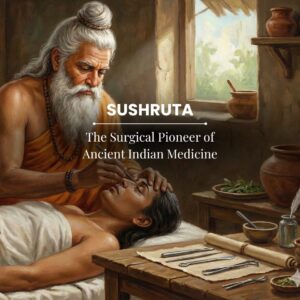
Dhanvantari’s knowledge appears in the Agni Purana. His disciple Sushruta carried his wisdom forward. People consider Sushruta as the Father of Surgery.
People worship Lord Dhanvantari for health. They remember him at the start of Diwali, and many temples in Kerala honor him. Several Ayurvedic hospitals in India worship Lord Dhanvantari before offering classical Panchakarma treatments.
Summary of Divine Outcomes of the Samudra Manthan
| Emerged Entity | What It Is | Significance |
| Sura | Goddess linked to alcohol | Represents intoxication and excess |
| Apsaras | Divine nymphs like Rambha and Menaka | Mark beauty, art, and attraction |
| Kaustubha | Precious Jewel | Represents divine wealth and purity |
| Uchchaishravas | Seven-headed divine horse | Symbol of royalty and power |
| Kalpavriksha | Wish-fulfilling tree | Represents abundance and the fulfillment of desire fulfillment |
| Kamadhenu | Sacred Cow | Source of nourishment and prosperity |
| Airavata | White elephant of Indra | Symbol of strength and rain |
| Lakshmi | Goddess of wealth and fortune | Represents prosperity and harmony |
| Parijata | Divine flowering tree | Symbol of beauty and heavenly joy |
| Halahala | Deadly poison | Represents destruction and imbalance |
| Chandra | The moon | Symbol of mind, rhythm, and time |
| Dhanvantari | Divine physician | Source of Ayurveda and healing |
| Amrita | Nectar of immortality | Represents life, renewal, and longevity |
The Samudra Manthan was not only about finding Amrita. After the ocean was churned, many forces originated and became powerful. Each one represented a force of nature, life, wealth, power, or danger.
The most dangerous outcome was Halahala, which spread heat and destruction across the world. No god or demon wanted to take it. So, Lord Shiva stepped forward and drank the poison to save the world. His throat turned blue, earning him the name “Neelkanth.”
After this sacrifice of Lord Shiva, harmony returned. Goddess Lakshmi chose Lord Vishnu as her consort. Finally, Lord Dhanvantari appeared with Amrita, the nectar of immortality.

How Did Dhanvantari Face the Power of the Serpent Goddess Manasa?
Ancient texts tell a powerful story about Dhanvantari and the serpent world. The Brahma Vaivarta Purana describes this event. Dhanvantari once met the forces of Vasuki, the serpent king. Then, the snakes released venom that caused Dhanvantari’s disciples to collapse.
Dhanvantari acted at once. He prepared medicine from Vanaspati, or healing plants. He gave medicine to his disciples, and poison lost its power. His disciples regained consciousness. It made serpents alarmed. Following, they sent Goddess Manasa to stop him. (Goddess Manasa, the queen of snakes)
A fierce clash followed and disturbed the balance of the worlds. At last, Lord Brahma and Lord Shiva intervened and restored peace.
What are the 8 Branches of Ayurveda? (Ashtanga Ayurveda)
Lord Dhanvantari organized Ayurveda into eight branches for people to understand health, disease, and healing. Together, these 8 branches of Ayurveda cover body, mind, senses, immunity, aging, and reproduction.
| 8 Branches of Ayurveda | Focused On | Includes |
| Kaya Chikitsa (Internal Medicine) | General health & disease treatment | This branch of Ayurveda treats fever, digestive issues, chronic illness, and lifestyle problems. It focuses on balancing Vata, Pitta, and Kapha by improving Agni. Uses diet, herbs, Panchakarma, and daily routines. |
| Shalya Tantra (Surgery) | Surgical treatment | Deals with wounds, tumors, injuries, fractures, abscesses, and more. Ancient Ayurveda explained surgical tools, stitches, and cosmetic surgery. Sushruta expanded this branch and became the Father of Surgery. |
| Shalakya Tantra (ENT & Eye Care) | All ailments above the neck region | Treats eyes, ears, nose, throat, teeth, and head disorders. Uses herbal medicines, oils, surgery, and Panchakarma therapies like Nasya. |
| Kaumarabhritya (Pediatrics & Obstetrics) | Mother and child care (pre- and postnatal) | Focuses on pregnancy, childbirth, newborn care, child growth, and childhood medical problems. Includes immune support, such as Swarna Prashana, dietary alterations, and children’s mental development. |
| Agada Tantra (Toxicology) | Poison toxin management | Treats poisoning from plants, animals, minerals, food, water, and the environment. Includes antidotes, detox therapies, and emergency care for stings and insect bites. |
| Bhuta Vidya (Mental Health & Psychiatry) | Mind and emotional balance | Treats anxiety, depression, fear, insomnia, and mental health problems. Use of herbs, counseling, meditation, mantras, and spiritual practices to calm the mind and balance all three types of doshas. |
| Rasayana Tantra (Rejuvenation & Anti-Aging) | Longevity and Vitality | Builds immunity, strength, memory, and youthfulness. Uses herbs like Ashwagandha, Guduchi, and Chyawanprash. Focuses on healthy aging and disease prevention. |
| Vajikarana Tantra (Reproductive Health) | Fertility and sexual wellness | Improves reproductive health. This includes strength, fertility, and hormonal balance. |
These eight branches matter because –
- They cover every stage of life. (From birth to old age)
- They treat body, mind, and senses together.
- They focus on prevention.
- They link medications to behavior, diet, and spirituality.
How Do People Honor Him Today?
Temples of Lord Dhanvantari are rare but respected by his followers around the world. Most of his temples stand in South India, and Kerala has some of the most famous temples. Devotees visit Thottuva Dhanvantari Temple and Nelluvai Dhanvantari Temple to seek blessings for their health and relief from illness.
Tamil Nadu also has strong traditions. A shrine to Dhanvantari exists inside the Sri Ranganathaswamy Temple in Srirangam. Priests give a special herbal drink as prasada there.
In the Tamil Siddha tradition, devotees consider Dhanvantari as one of the 18 Siddhars. His Jeeva Samadhi lies at Vaitheeswaran Koli.
Outside South India, Lord Dhanvantari temples stand in Dapoli, Maharashtra; the Jaya Bageshwari area of Kathmandu; and a 25-acre wellness center in VVAC, Himachal Pradesh.
People celebrate Dhanvantari Jayanti as Dhanteras every year. It falls on the 13th lunar day of Krishna Paksha in Kartik. Devotees light lamps and worship Goddess Laxmi for prosperity and fortune.
In 2016, the Government of India named Lord Dhanvantari’s Jayanti as “National Ayurveda Day.” This honor recognizes Dhanvantari’s contribution to medicine and deep healing. The first Ayurveda Day was celebrated on 28 October 2016.
However, due to annual changes in Dhanteras Day, the date of Ayurveda Day shifted. On 23rd March, 2025, an announcement was made regarding its change. Ayurveda Day will be celebrated on 23rd September every year.
Lord Dhanvantari Mantra
ॐ नमो भगवते वासुदेवाय धन्वंतरये अमृतकलश हस्ताय सर्वामयविनाशनाय त्रिलोक्यनाथाय श्री महाविष्णवे नमः
|| Om Namo Bhagavate Vasudevaaya Dhanvantaraye Amrutha-Kalasa-Hasthaaya Sarvaamaya-Vinaashanaaya Tri-Lokya-Naathaaya Shri Mahaavishnave Namaha ||
Devotees chant this mantra to seek blessings for good health and a disease-free life.