Ayurveda is not just a medical system; it is a complete science of life that teaches how to live in balance, prevent diseases, and heal the body naturally at its roots. Among the visionary sages who contributed to the development of Ayurvedic wisdom, Acharya Charaka stands tall as one of its strongest pillars. Also deemed to be the “Father of Medicine.”
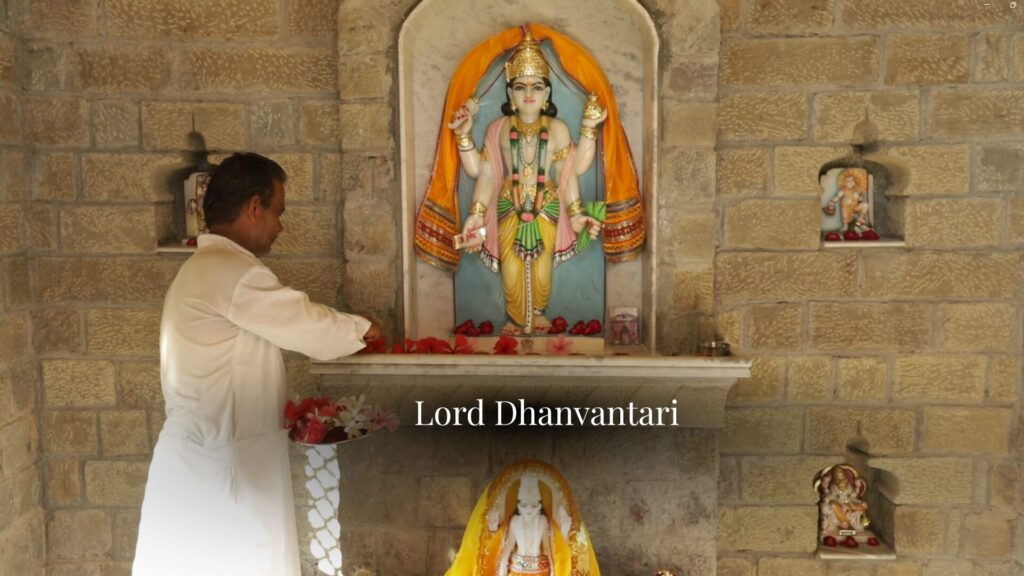
Ayurveda is traditionally believed to have originated from Lord Dhanwantri, the divine physician of the gods, who received this knowledge from Brahma. (The creator of this universe) Its earliest roots are found in the Atharvaveda (around the 2nd millennium BCE), where healing was closely linked with rituals, herbs, and protective chants.
In the Vedic period of medicine (up to 800 BCE), several diseases like cough, flu, diarrhea, tumors, skin disorders, and seizures were described along with respective medicinal plants used for treatment.
Who Was Acharya Charaka?
Acharya Charaka is remembered as one of the greatest Ayurvedic physicians in the history of Ayurveda. The name “Charaka” comes from the Sanskrit phrase “Charati iti Charakaha,” meaning one who keeps moving.
He totally justified his name; Charaka was a wandering healer who traveled from place to place, treating the sick and spreading medical knowledge. Although being the backbone of Ayurveda, very little is known about his personal life, birth, or family. Traditionally, he is believed to have served in the court of King Kanishka as a physician.
Some classical traditions describe him as an incarnation of Shesha, the cosmic serpent, or as a disciple of Vaishmpayana.
Based on historical and textual evidence, scholars place Acharya Charaka between the 3rd and 2nd century BCE, making him one of the earliest and most influential thinkers of Ayurveda. (Preceding some renowned scholars like Vagbhata.) Speaking about his life, it reflects a rare blend of compassion, curiosity, and deep commitment to healing humans through the science of Ayurveda.
Why Acharya Charaka Is Called the Father of Medicine
Acharya Charaka earned the title “Founder of Ayurveda” not because he treated diseases, but because he changed how medicine was understood forever. His initial contribution was to transform the basis of healing from merely guesswork to a more logical, ethical, and quantifiable approach.
What Charaka Established First
Considered the “Founder of Ayurvedic Medicine,” Charaka was among the earliest physicians to highlight that:
- Good health is a byproduct of harmonious natural laws and not by chance.
- Every ailment has a cause, intensity, and a sustainable solution.
- Prevention is better than a cure. (everyone has heard it)
- A physician’s ethics and intent are as vital as the medicine itself.
Charaka didn’t just stop at broad principles-he was adamant that effective treatment depended on knowing the patient as a whole. He believed that a physician who treat blindly, without considering the patient’s full life context, is bound to miss the mark. Instead, he emphasised the importance of understanding every factor affecting a person: their habits, environment, and unique constitution. Only by customising treatment to the individual, Charaka argued, could a physician hope to restore true health.
These principles are so powerful that they are still the basis of Ayurveda practiced today.
Charaka Samhita: How a Medical Classic Came into Light
The Charaka Samhita did not appear overnight as the prestigious work of one author. Its journey reflects the collaborative and evolving nature of Ayurvedic knowledge over centuries. The original text, earlier known as the Agnivesha Tantra, was composed by Agnivesha, who was the disciple of the teacher Punarvasu Atreya.
Acharya Charaka took this foundational work and refined, expanded, and reorganized it to give depth, clarity, and clinical precision. Centuries forward, the scholar Dridhabala completed the text by restoring and adding 17 missing chapters to continue it for generations ahead.
Combining the Sushruta Samhita and Ashtanga Sangraha, the Charaka Samhita forms the Brihat Trayi. (Together, they are the three authoritative pillars of classical Ayurvedic literature.)
Structure of the Charaka Samhita: A Well-Organized Documentation
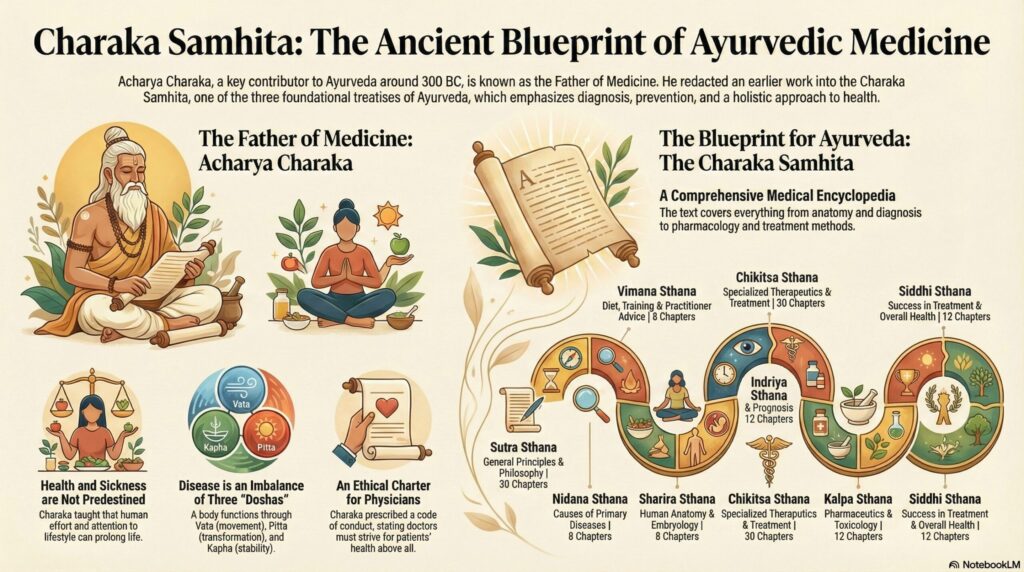
The Charaka Samhita is a Vata and carefully structured medical text, consisting of 8 Sthanas (sections), 120 chapters, and nearly 9,300 verses (Sutras). Each section has a distinctive purpose to understand health, disease, and respective treatments.
- Sutra Sthana: It lays the foundation of Ayurveda as it explores core principles, medical philosophy, daily routines, diet, and overall treatment strategies.
- Nidana Sthana: Focuses on the causes, progression, and diagnosis of major ailments and helps physicians identify illness at an early stage.
- Shareera Sthana: Related to human anatomy, embryology, and physiological development, showing an advanced understanding of the human body.
- Vimana Sthana: Explains dietary science, measurement of bodily factors, ethics, and clinical reasoning, guiding doctors on how to think and treat what is required.
- Indriya Sthana: Concentrates on prognosis, helping physicians recognise signs that indicate recovery or decline through sensory modalities.
- Chikitsa Sthana: It is the heart of the whole text and also the largest section. It details disease-specific treatments forming the foundation of Kayachikitsa (internal medicine).
- Kalpa Sthana: Focuses on pharmacology and toxicology, including preparatory methods for potent medicines and antidotes.
- Siddhi Sthana: Explains the proper use of Panchakarma therapies along with post-treatment care with long-term guidance.
Charaka’s Early Insights on Genetics and Congenital Conditions
Even prior to the human genome becoming known in the current era, Charaka showed some amazing foresight concerning inheritance and birth defects. Charaka believed that the causes of such defects did not necessarily emanate from the physical well-being of the parents. Rather, Charaka suggested that there could be some form of alterations or defects that occurred at the point of conception, either in the mother’s or the father’s gamete.
He was convinced that these factors, which are invisible but basic in nature, are the reasons for the birth of some children who had certain conditions which could not be linked to any illness or defect on the part of the parents. These scientific insights form the basis for the genetic science of today, which shows how forward-looking Charaka was.
This forward-looking insight was ahead of its time in terms of genetic science.
How Did Charaka Emphasize the Importance of Personalized Treatment in Medicine?
Centuries before the concept of personalised medicine became popular, Acharya Charaka recognised that every individual is unique. He believed that effective treatment should never be based on symptoms alone. Instead, a physician should understand the patient’s body constitution (Prakriti), lifestyle, diet, mental state, environment, and daily routine before recommending any therapy. By focusing on the individual rather than just the disease, Charaka’s approach aimed to treat the root cause and promote long-term health. This patient-centred philosophy remains one of the defining principles of Ayurveda even today.
Core Medical Philosophy of Acharya Charaka
Charaka explained that the human body is governed by three functional forces known as Doshas. The three types of Dosha are:
- Vata, which controls movement and nerve activity.
- Pitta, which manages digestion, metabolism, and transformation.
- Kapha, which provides strength, structure, and lubrication to the body.

According to Charaka, health exists when these three doshas remain in harmony. When even one dosha becomes disturbed, it invites disease. Also, he strongly advocated that preventing illness is more powerful than treating or curing it later. For this reason, he advised living in harmony with nature, daily rhythms, and seasonal changes rather than reacting only after disease appears.
Charaka also emphasised the importance of diet, routine, and lifestyle as the first line of medicine, long before medical intervention is required. Furthermore, he documented the medicinal properties of nearly 100,000 herbs, illuminating the scope of natural healing through plants.
Charaka was among the earliest scholars to explain the role of digestion (Agni), metabolism, and immunity as the foundation of physical strength and disease resistance. Based on the study “Physiological Aspects of Agni” published in the Journal AYU, Agni is the core force behind digestion, metabolism, and tissue nourishment.
This study identifies 13 types of Agni, with Jatharagni as the master regulator, supported by Bhutagni and Dhatvagni for elemental and tissue-level metabolism. The research also concluded that healthy metabolism depends on properly balanced Agni, which Acharya Charaka explained several years ago.
Finally, his philosophy established that a strong digestive system and a balanced lifestyle are the roots of long-term health.
Medical Ethics: Charaka’s Code for Healers
- Healing must be done with complete dedication and compassion
- Health seeker confidentiality is sacred and must be protected at all costs
- A physician should remain loyal to the health seeker, even if it means at personal risk
- Intoxication and unethical companies should be strictly prohibited
- Consistent learning and moral discipline are essential for a doctor
Health and Habitat: Role of Geography (Desha)
- Jangala Desha: Dry, arid regions dominated by the space element, people are generally strong.
- Anoopa Desha: In marshy, water-rich areas, individuals are more delicate.
- Sadharana Desha: Balanced environment with moderate health qualities. Medicinal herbs derive potency and names from their geographical origin.
Academic and Historical Firsts
- The first documented medical conference was held by sages in the Himalayas.
- First known redaction and systematic revision of a medical text.
- First instance of medical dictation by Acharya Atreya to Agnivesha.
- Establishment of standardized and council-approved medical references.
Legacy and Global Influence
- Inspired over 40 classical Sanskrit commentaries
- Ayurveda Deepika by Chakrapani is the most renowned commentary
- Translated into Arabic, Persian, and Latin in early centuries
- Global recognition through initiatives like Charaka’s Club, New York (1898), where physicians studied and discussed the history and philosophy of medicine
The influence of Charaka is not confined to the ancient world of India alone; the Charaka Samhita is regarded as the foundation of Ayurveda. Through the Charaka Samhita, Charaka has laid down the principles of Ayurveda and thus helped give rise to holistic medicine that lives on through the ages.
His vision stressed the interrelation of body, mind and environment. A perspective that anticipated many modern holistic health practices. The emphasis on prevention, lifestyle, and the root causes of illness places Charaka among the earliest proponents of what today would be called integrative or preventive medicine.
While some of Charaka’s ideas have been revised or replaced by contemporary science, his insistence on individualised care, ethical conduct, and the unity of life’s elements has influenced not only Ayurveda but also the wider world of global medicine. The reverberations of his work are still felt in the growing interest in natural healing, wellness, and the integrative medicine movement across continents.
FAQ’s
1. Why is Acharya Charaka called the Father of Medicine?
Acharya Charaka created the foundation for internal medicine (Kayachikitsa). He defined diagnosis, explained the causes of diseases, and set medical ethics.
2. What are the 4 Pillars of Ayurveda?
The four pillars of Ayurvedic medicine that help patients are Bhishag (Physician), Rogi (Patient), Dravya (Medicine), and Upastha (Medical Attendant or Nurse).
3. How is Ayurveda different from modern medicine?
Modern medicine focuses on managing symptoms. Ayurveda focuses on finding the root cause, preventing illness, and restoring balance in both body and mind.
4. Who is the Father of Ayurveda: Charaka or Dhanvantari?
Both Charaka and Dhanvantari are called the “Father of Ayurveda.” The main difference is that Dhanvantari brought Ayurveda to humans. While, Charaka is the human father of Ayurvedic teachings.
5. Is Ayurveda the same as Traditional Chinese Medicine (TCM)?
No, although both are ancient holistic systems, Ayurveda is based on Doshas (Vata, Pitta, Kapha) and Agni. While Chinese medicine focuses on Yin-Yang and Qi. Their philosophies, diagnoses, and treatments are different.
6. Is Ayurveda only for treating diseases?
No, Ayurveda also focuses on maintaining health. It means improving quality of life, increasing longevity, and preventing future illnesses.
6. When did Charaka die?
According to available sources, Acharya Charaka was born around 300 BC, but the date of his death is unclear. He is believed to have lived during the 4th century BCE.