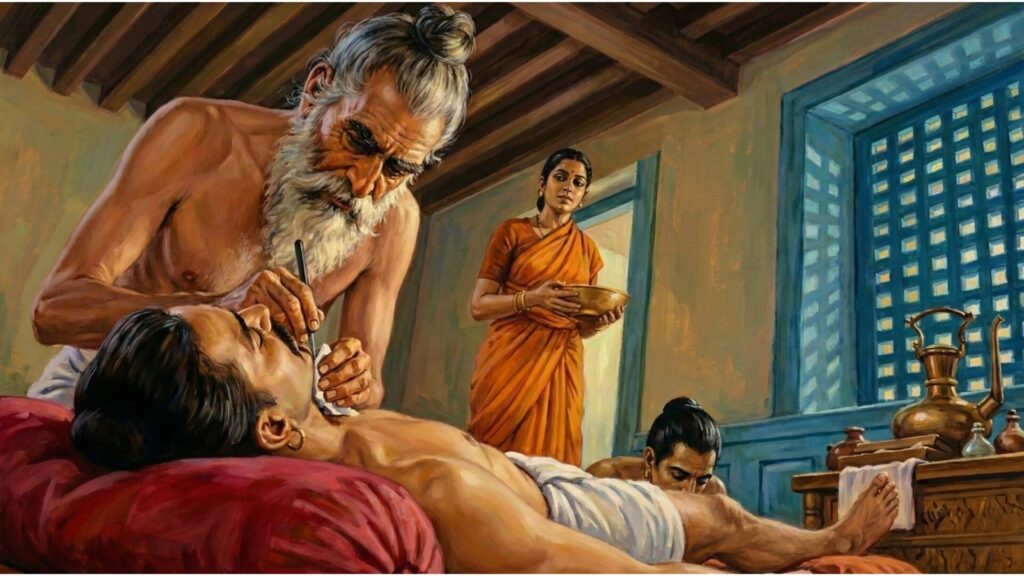
Sushruta, “Father of Surgery”, lived in the ancient city of Kashi around 600 BCE. Sushruta adopted a bold and practical approach during a time of change in medicine. It happened across India, Egypt, China, Greece, and Mesopotamia. He changed how people understood surgery.
Before Hippocrates and Galen, Sushruta was a surgeon. Known to be the “Father of Surgery” and “Father of Plastic Surgery”, he worked in different fields. Several fields include:
| Surgery | Gynecology | Eye care |
| Anatomy | Plastic and Reconstructive Surgery | Obstetrics |
| Orthopedics | Trauma Care | Pharmacology |
He wrote everything about surgery in the Sushruta Samhita. It is the oldest surgical text in the world. This ancient text covers in great detail:
- Anatomy
- Diseases
- Surgical tools
- Steps of surgery
- Care after surgery
The book discusses the importance of cleanliness and the proper use of surgical instruments. Also mentioned ethical decision-making. Also, he taught his students about the human body through human corpses. He focused on early methods for controlling pain and on the use of anesthesia in surgery. Sushruta’s methods changed Ayurvedic surgery. He influenced the development of modern surgical science worldwide.
What is the Structure of the Sushruta Samhita?
Sushruta didn’t compile a book. He built a strong backbone of surgical science that the world follows today.
- The Sushruta Samhita is a landmark in medical history. (World’s oldest surgical book)
- It contains 6 major sections (Sthanas) and 186 chapters. It covers theory and practical practice.
- Sushruta described 1,120 diseases with a deep understanding of pathology. Even before modern diagnostics came.
- The text lists 700 medicinal plants and medicines from animal and mineral sources.
- It explains human anatomy, embryology, toxicology, and disease intensity in detail.
- Sushruta taught in ancient Banarasi (Kashi) and established medical ethical codes for physicians.
- He trained students to examine patients using all five senses. Also, he linked malaria to mosquitoes and plague to rats. (Long before the germ theory)
- Sushruta identifies diabetes by tasting urine and recording its honey-like sweetness.
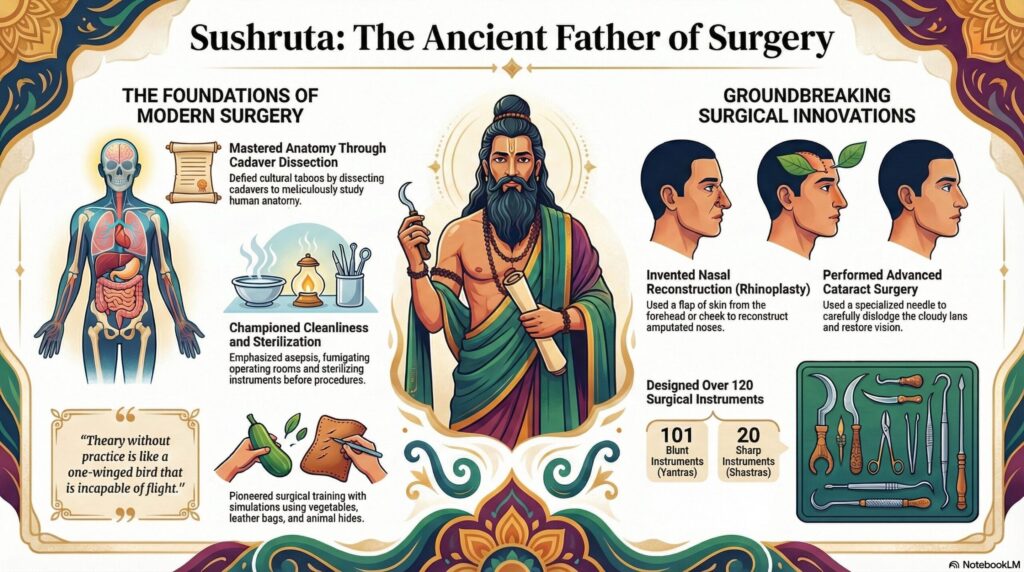
- Also, the text documents 20 sharp instruments and 101 blunt instruments. (Majority made of steel)
- Students practiced surgery using everyday objects. It showed Sushruta’s practical teaching method.
- Ancient surgeons performed advanced operations. Some of them are tumour removal, abscess drainage, hernia repair, cesarean sections, amputations, and fracture management.
- Earlier, hot oil and tar controlled bleeding. Also, the early anesthetic was alcohol.
- Sushruta introduced plastic surgery, particularly nose reconstruction using cheek or forehead skin flaps.
- He also described cataract surgery by lens displacement to restore vision.
What was Sushruta’s Surgical Technique? Anatomy, Training, and Reconstruction
| Area of Contribution by Sushruta | Key Details and Practices |
| Approach to Anatomy | Sushruta believed surgery without anatomy was dangerous. He insisted that every surgeon must study the human body in detail. Especially the times when touching human corpses was taboo. |
| Cadaver Selection | Bodies had no positioning, severe ailments, or decomposition defects to ensure accuracy. |
| Unique Dissection Method | The body wrapped in grass or hemp, placed in a cage, or submerged in the water for 7 days, softens the tissues. |
| Layer-By-Layer Study | After removal, students scraped the area with bamboo or grass-root brushes. It helped them observe skin, muscles, organs, and structures one layer at a time. |
| Training Philosophy | Sushruta stated that theory without practice is like a bird with one wing. It CANNOT FLY. So, skill and knowledge had to grow together. |
| Student Preparation | Surgical students studied for at least 6 years and took a solemn oath. Also, they practiced with natural and household models before real surgery. They practiced incising vegetables such as gourds, squash, and watermelons. Suturing practice performed on cloth pieces, leather, and animal hides. Students conducted probing practice on worm-eaten wood to duplicate sinuses and fistulas. They used fruits such as jackfruit (Panasa) to simulate cataracts. Sushruta stressed the importance of hygiene during surgery.He also focused on careful cleaning of instruments and ethical conduct by surgeons. Sushruta introduced reconstructive surgery and nasal reconstruction (rhinoplasty). Surgeons measured the missing nose using a leaf or made a creeper as a template. Hollow reeds or castor plant tubes kept in the nostrils maintained breathing and shape. The surgeon freshened the nasal stump and stitched the flap into place. |
| Post-Surgery Care | Herbal powders of licorice, red sandalwood, and barberry applied to enhance healing. After the application, surgeons used a cotton dressing and sesame oil. |
| Other Plastic Procedures | He described the repair of torn earlobes. Also, he mentioned 15 types of otoplasty, cleft lip correction, and skin grafting. |
| Burns & Trauma | He classified burns into four degrees. He explained heat stroke, frostbite, and lightning injuries. |
| Surgical Instruments | Fine steel tools, needles made of bronze or bone, and sutures made of bark, hair, silk, and tendons used by the surgeons. |
| Scar Precision | He emphasized minimal scarring and hairline suturing to promote healing and improve appearance. |
| Pedicled Flaps | Described early versions of pedicled, sliding, and rotation flaps. They are the foundations of modern reconstructive surgery. |
| Global Spread and Modern Link | Knowledge of pedicled flaps travelled from India to Europe. It influenced surgeons like Tagliacozzi and the Branca family. Sir Harold Gillies made pedicled flap surgery widely known during World War I.Because of this work, people now call him the father of modern plastic surgery. Sushruta did NOT describe the forehead “Indian Flap” method. It spread among potter families. |
| 1794 Historical Event | British surgeons saw the rhinoplasty surgery on Cowasjee in Pune. Potters performed the surgery. They used a forehead skin flap. Tipu Sultan’s soldiers had amputated the nose. The Madras Gazette and Gentleman’s Magazine published this case. It shocked the world of Western medicine. |
| Educational Legacy | Modern medical education now works on Sushruta’s balance of ethics, skills, and theory. Reaffirmed in India’s 2019 competency-based curriculum. |
What are Sushruta’s 8 Surgical Techniques?
Sushruta grouped all surgical procedures into eight types, known as Shastrakarma. This clear system helped surgeons choose the right one for each condition. These categories are still practical today.
Chedana
Chedana, or excision, removed diseased or dead body parts. Sushruta insisted on clean cuts, correct depth, and minimal damage to healthy tissues. He used sharp tools, like
- Mandalagra
- Karpatra
- The texts include Vriddhipatra, Nakhasastra, Mudrika, Utpala Patra, and Ardhadhara.
Also, his extensive knowledge of anatomy guided every incision during the treatment.
Bhedana
Bhedana is the incision method. It involved opening abscesses or cavities. This helped release pus, blood, and trapped infected fluid. Sushruta taught surgeons to separate healthy tissues from the infected ones. (Before performing surgery.) He emphasized the importance of surgery aftercare. Aftercare supported healing and prevented infection. He used tools like Vriddhipatra, Nakhasastra, Mudrika, Utpala Patra, and Ardhadhara for incisions.
Lekhana
Lekhana, or scraping, removed superficial debris, dead tissue, or infected layers. Surgeons didn’t scrape the affected area in the opposite direction of the hair growth. It was to avoid the pain and bleeding. This method treated ulcers, skin issues, and abscesses. Instruments like Mandalagra and Karpatra removed the infected tissues.
Vedhana
Its use is to puncture to drain excess fluids. Sushruta used Vedhana to treat conditions such as hydrocele, ascites, and pustular swellings. Also, he warned against careless punctures that damage surrounding tissues. Surgeons used tools like Kutharika, Vrihimukha, Ara, Vetasapatra, and Suci for careful drainage.
Eshana
Eshana assisted surgeons in exploring deep wounds and sinuses. It allowed them to locate foreign bodies, hidden debris, or abnormal wounds. It was helpful in sinus wounds and ulcers with trapped objects. Surgeons guided a sharp probe called Eshani to assess the damage.
Aharana
It is an extraction method that focuses on removing solid blockages from the organs. This included bladder stones, teeth, dental deposits, foreign objects, and affected feces. In case of bladder stone cases, surgeons positioned the patient. Followed by using tools like Badisa and Dantasamku. After surgery, physicians prescribed a warm, light diet for enhanced healing.
Visravana
This surgical technique involved draining pus, blood, or toxic fluids to reduce pain and swelling. Doctors treated abscesses and infections with small cuts. They also used leech therapy for tooth problems and swollen, inflamed areas. Some tools that helped prevent infection are –
- Suci
- Kushapatra
- Atimukha
- Sararimukha
- Antarmukha
- Trikurcaka
Seevana
Seevana, or suturing, closed wounds and supported proper healing. Sushruta described various stitching methods, including straight, zigzag, continuous, and interrupted patterns. At that time, surgeons used silk, plant fibres, and hair to stitch wounds. He also warned surgeons not to suture infected wounds, as this can worsen the healing process.
What are Sushruta’s Surgical Instruments and Sterile Practices?
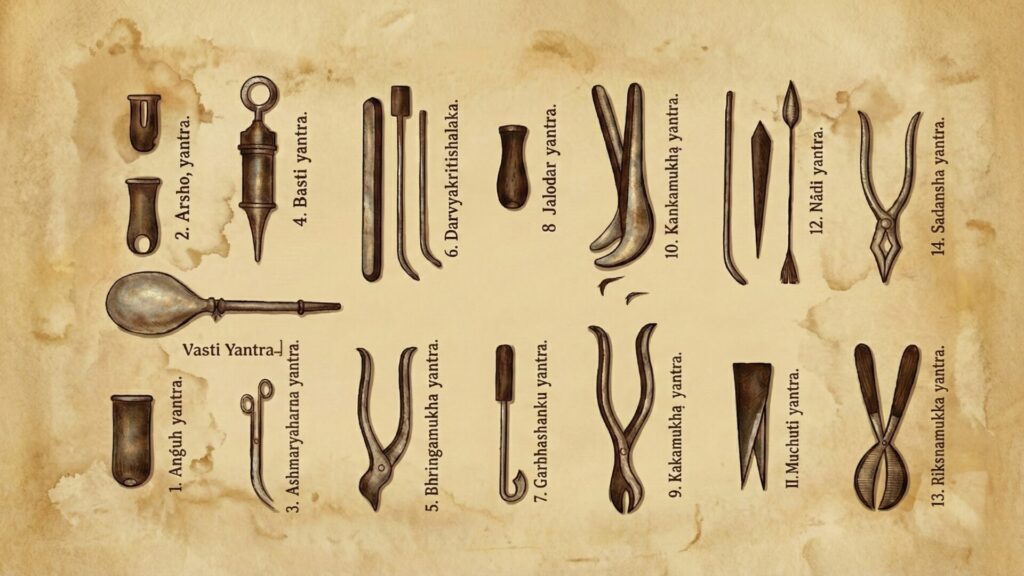
- Sushruta described 121 surgical instruments in detail. He divided them into Yantras and Shastras. Yantras, like forceps, were blunt instruments, and shastras were sharp instruments, such as scalpels and needles.
- He insisted that surgeons use strong metals. Some of the metals were iron, copper, or gold. He believed that these tools made surgery safer and more accurate.
- He emphasized cleanliness long before people knew about germs. He asked surgeons to keep the surgical area clean at all times.
- Also, he cleaned the operating rooms using fumigation (Dhoopana). He burned mustard, salt, and clarified butter to purify the air.
- He managed pain using early anesthesia. He used wine in the surgeries to reduce pain. Cannabis smoke or incense helped calm patients during the surgery procedure.
Sushruta and the Sushruta Samhita: Foundations of Surgical Science in Ayurveda
This research paper highlights Sushruta’s central role in shaping Ayurveda. The text came from the Dhanvantara lineage. It organized surgery, anatomy, disease study, poisons, and ethics in a clear way. Sushruta linked surgical science with Ayurvedic principles. It mentioned cadaver dissection, advanced instruments, plastic surgery, and emergency care. His work made surgery a part of Ayurveda and shaped medicine in Asia and the Middle East.