Ayurveda vs modern medicine is a debate we often hear. Ayurveda is over 5000 years old, and modern medicine is instant, scientific, and rapid. But! Here comes the irony. India gave Ayurveda to the world. Yet many people trust modern medicine more than Ayurveda.
However, Ayurveda vs modern medicine is not about the old medical system against the new. It’s about understanding health in a holistic way. Allopathy, or the modern-day medical system, revolves around quick relief from ailments. People believe allopathic treatments offer clear and accurate diagnoses. Often, considering them to be better than the Ayurvedic medical system. But Ayurveda looks at the root cause of the health issue. Also, Ayurvedic therapies provide long-term and sustainable wellness.
So, why this debate, even when Ayurveda came before modern science? Rather than choosing a single medical system for cure and prevention, people should enjoy both. Because these two systems work together instead of working against each other.
Now, let’s break down this debate in a simple way and have a final verdict.
What is Ayurveda?
The healthcare scene never remains the same. It has seen changes over 2000 years. Today, health seekers don’t view their health as the result of a single factor. They want the speed of modern medicine and the depth of the Ayurvedic medical system. So, the future of medicine is not Ayurveda vs modern medicine. It is the integration of both the sciences for wellness and preventive care.
We know that modern medicine can manage emergency situations, surgeries, infections, and trauma. In Ayurveda, the aim is to correct the balance between the body, mind, and soul. The corrections begin at the root.
Rather than focusing on which is better, the real question should be how they can support each other.
What Does Ayurveda Mean?
Ayurveda means “Science of life, and the words come from –
Ayur (life) and Veda (knowledge)

The Ayurvedic medical system is not a recent development, unlike modern medicine. It dates back 5000 years and is known to treat illness at its roots. In simple terms, it teaches individuals to live well each day.
Now, it is important to understand the life-changing effects of Ayurveda on the human body. As per Ayurveda, every individual functions in a unique way. Also, it explains health through three life energies (Tridoshas).
The three types of doshas that govern all the body functions are Vata, Pitta, and Kapha. The tridoshas govern all body functions, and each dosha is responsible for different functions.
If you want to find out which dosha is dominant in you, take this 5-minute quiz from VVAC. This quiz can help you understand your body and restore balance to maintain health.

Ayurveda says that when these doshas stay in balance, the chances of diseases are less. And diseases start when they lose balance.
Panchakarma treatments in Ayurveda vary across individuals because individuals differ in their physiology. Each body has a unique body constitution, known as Prakriti. That is why Ayurvedic physicians prescribe personalised medicine and a treatment plan for holistic wellness.
Is Ayurveda only About Herbs?
The answer is clear: “NO.” Ayurveda is a holistic medical science. It includes everything from food, sleep, emotions, and environment to lifestyle. A consistent and healthy Dinacharya (daily routine) helps an individual to lead a stable life.
Also, Dinacharya helps people adapt to seasonal changes, known as Ritucharya. Only a person who follows a consistent daily routine can adapt to harsh climatic changes. It’s understandable! Isn’t it? Because we all experience it on a personal level.
What is Modern Medicine?
The first thing that comes to our mind when we talk about modern medicine is “allopathy” or “pills.” Although modern medicine dates back 150-200 years, it has transformed the global medical scene.
It stands on evidence, cause, effect, clinical trials, and evolving technology. It studies the body as a machine and treats it with accuracy. Like a machine has parts, with each part having a different function, the body is a system of organs and structures. Doctors treat damaged parts of the body and maintain the normal functioning of the whole body.
The best part about modern medicine is that it acts fast. During times of emergencies like accidents, heart attacks, brain strokes, or severe infections, only medicine can come to the rescue. With the help of antibiotics, antivirals, surgery and intensive care, these serious situations are handled.
Also, doctors test patients using blood tests, scans, MRI, CT scans, and other technological advancements. This enables the specialists to diagnose and treat the issue at the right time. In simple terms, technology, medicines, and machines are the backbone of modern medicine.
Let’s view how medicine treats disease:
- It targets symptoms of the ailments
- Drugs block pain, reduce inflammation, control and kill microbes
- They focus on short-term instant relief that controls the intensity of the ailments
Alas, modern medicines do not come without problems. Long-term use of drugs causes side effects. Yes, it does control symptoms, but fails to address the root cause in some cases.
Now that you are aware of the traditional and modern medical systems, let us list their differences.
Ayurveda vs Modern Medicine: A Comparative View
| Category | Ayurvedic Medical System | Modern Medicine | What health seekers derive? |
| View of Health | Ayurveda, known as “Science of Life, revolves around maintaining the balance between body and mind. | Views good health as a result of the absence of diseases. | So, Ayurveda highlights the prevention of diseases and modern medicine |
| Understanding the Human Body | Ayurveda treats the body as a holistic system that interconnects with lifestyle, diet, mind, soul, spirit, and others. | It considers the human body as a machine with several body parts with specific functions. | Ayurveda works on every part of the body to be in sync. Modern medicine targets a specific system to remove the ailment. |
| Basis of Diagnosis | Ayurvedic doctors use pulse reading, dosha imbalances, lifestyle, body constitution, and other factors to read the cause of the problem. | Medical science uses technologies such as body scans, blood tests, imaging, and biomarker tests. | One is instrumental, and the other is experiential. But today, modern technology, such as Artificial Intelligence, is a part of Ayurveda. (A significant step. Right?) |
| Personalisation of the treatment | Classical Panchakarma treatment in Ayurveda gives different results to different people. This occurs because individuals have different body types. (Prakriti) | Drugs and medical treatments have standard protocols that are similar for people with similar health conditions. For instance, the medicine for a stomachache will work in the same manner for different people with pain. | On comparing the two health systems, Ayurvedic treatments mould according to the person. |
| Approach to Ailment | Identification of the problem through analysing the dosha imbalance. | Scientific diagnosis of the disease for the accuracy of the problems and treatment. | Long-term and sustainable wellness v/s instant correction. |
| Pillars of the Medical System | Ayurvedic treatments have several pillars, such as: DietHerbsPanchakarmaYogaLifestyle alteration | Modern medicine has pillars: Drugs or Pharmaceuticals Surgery Radiation Medical instruments | Natural basis of correction and chemical intervention. |
| Time of Result | Ayurvedic treatments are slow but have long-lasting results. | The speed of the result is quick or instant. | Slow v/s fast |
| Best Used | Chronic ailments with no SOLUTION in modern medicine. Also, lifestyle disorders such as hypertension, diabetes, anxiety, and others. Ayurvedic therapies help prevent diseases, too. Ayurveda assistive care is also famous. | Emergency situations, infections, traumas, or acute care are some conditions where modern medicine works. | Useful and effective in different situations. |
| Side Effects | Ayurveda is one of the safest medical systems with respect to side effects. Ayurvedic doctors use herbal medicines, aushadhis, and oils to treat diseases. They have few to no side effects on the body. In short, safe to use. | Modern medicine comes with side effects. Resistance to drugs is one of the major concerns. According to the WHO report of 2008, multidrug-resistant TB caused around 15,000 deaths globally. | The risk of side effects depends on the duration and dosage of the medicine. |
| Role of Diet | Diet is one of the many important pillars of Ayurvedic treatment. | Diet is important in modern medical treatment, too. But it plays more of a supportive role. | Ayurveda considers diet as a medicine. |
| Global Acceptance | Ayurveda is gaining global acceptance, especially in integrative medical science. | Medical science is universally accepted and follows standard protocols. | Integrating both the medical systems offers the best results. |
The Integration: How Ayurveda and Modern Medicine Work Together
So, there should be no “Ayurveda vs modern medicine” debate. Because they are not against each other. If combined, they actually support each other. Today, the healthcare system is moving towards one thing, which is “Integration.”
As per the practical approach, doctors combine Ayurveda’s deep wisdom with modern medicine’s science. So, instead of only benefiting from one medical system, choose the combination of the two.
The integration is no longer global; India is already on the list. In India, the Ministry of AYUSH and the National AYUSH Mission brought Ayurveda to the public. There are several Ayurvedic hospitals, retreats, wellness centres, colleges, and research centres that collaborate with modern medicine institutes.
In fact, leading hospitals such as AIIMS and Tata Memorial Hospital collaborate with many Ayurvedic physicians. It doesn’t end here! The doctors use Ayurveda for disease management, post-treatment care, pain management, and others. For example, cancer has no treatment in Ayurveda. But Ayurvedic treatment can help in the supportive care of cancer.
What About Scientific Proof? Yes, institutions help with it. In India, the All India Institute of Ayurveda (AIIA) approves Ayurvedic treatments. Validation of these Ayurveda therapies uses modern research methods. Organisations as Shuddhi HIIMS document:
- Clinical outcomes
- Conduct trials
- Build evidence-based models for Ayurveda
When Should You Choose Which System?
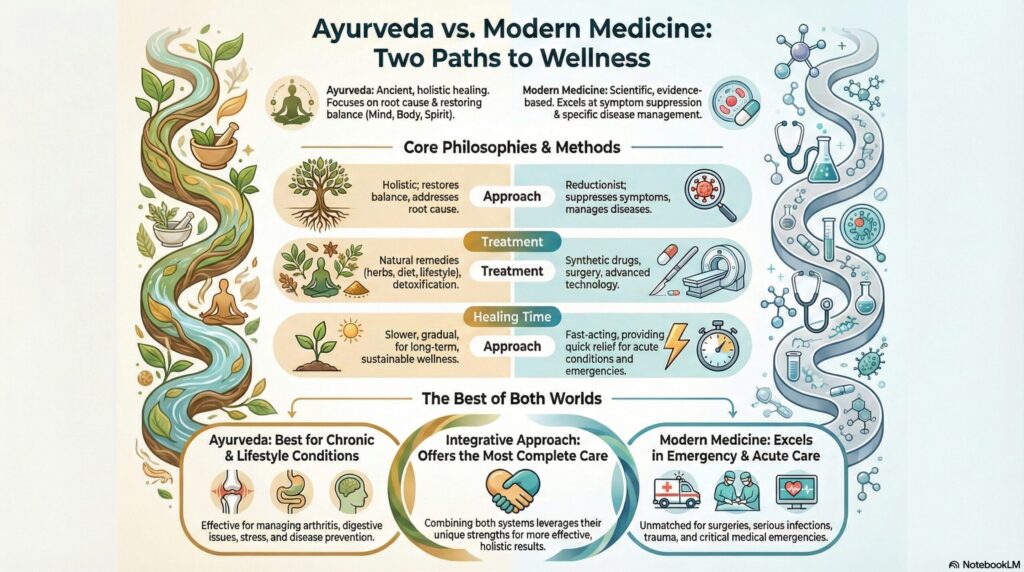
So, how can you decide between Ayurveda and modern medicine? The answer is very simple: “Depends on what your body needs at the moment.”
Now, when does Ayurveda work best? Ayurveda shines in long-term and lifestyle-related disorders. List of lifestyle-disorders are:
Arthritis, diabetes, asthma, IBS, skin disorders, or stress-related problems. Here, Ayurveda corrects digestion, metabolism, sleep, and daily routine. It works to:
- Prevent diseases
- Build immunity
- Balance mental state
- Enhance holistic wellness
Why Does an Integrated Approach Make Sense?
No one should underestimate the power of integrative medical systems. A person can enjoy modern science and Ayurvedic treatments together. Key benefits of this Integrated approach are:
1) Fewer side effects of the drugs or reducing their toxic load
2) Possibility of personalised treatments as per the body type (Prakriti)
3) Improved long-term recovery and balance in the body
4) Enhanced immunity and resilience to fight diseases
5) Detox through classical Panchakarma therapies
This integration approach doesn’t come without any challenges or limitations. Ayurvedic medicines may vary in quality. Some herbs should not be combined with certain pharmaceutical drugs. Why? Because the effects can cancel out each other or do the opposite.
What does the Future of Healthcare Look Like?
Where can we go from here? The answer is simple and direct. Healthcare cannot belong to only one medical system. The next phase of healthcare highlights patient-centric care. This approach works in collaboration to provide health seekers with the best treatment.
By now, we know that modern science offers accurate and life-saving medical technologies. Ayurveda brings prevention, lifestyle wellness, and long-term health. In the future, hospitals will use advanced scans and lab tests for accurate diagnosis. Also, Ayurveda will step in to guide a lifestyle for mental well-being.
In fact, Ayurveda has met Artificial Intelligence, which will bring revolution in the Ayurvedic medical system. To conclude, let us drop this long-standing debate of Ayurveda vs modern medicine and accept the integration of the two.

FAQs on Ayurveda vs Modern Medicine
- Can Ayurveda Replace Allopathy?
There is no question about it. Neither Ayurveda nor Allopathy can replace the other. They work best together.
- For Which Disease is Ayurveda Best?
Ayurveda treatments work for the management of the following chronic conditions:
- Arthritis, diabetes, IBS, asthma, stress, anxiety, lifestyle disorders, and more.
- Can I trust Ayurveda?
Yes, Ayurveda is not a recent medical science. It dates back 5000 years. Millions of health seekers trust it for their wellness, recovery, and holistic health.
- Is Ayurveda scientifically proven?
Yes, many core Ayurvedic principles, herbs, and therapies are supported by modern research and clinical studies.
- Which god created Ayurveda?
Lord Dhanvantari created Ayurveda. Known as the god of Ayurveda was an incarnation of Lord Vishnu.
- What are the golden rules of Ayurveda?
Ayurveda has some golden rules. They are –
- Balancing the three types of doshas
- Diet as per the digestion
- Follow a proper dinacharya
- Prevention is better than a cure
- What are the four pillars of Ayurveda?
The four pillars are Aushadhi (medicines), Ahara (diet), Vihara (lifestyle), and Achara (conduct).