How Undigested Food Becomes Disease – Complete Guide to Cleansing
Do you know that a simple digestion issue may affect your general health? If you are facing digestion due to a malfunction in your Agni (digestive fire), the food you eat can be converted into Ama, which is considered to be the main cause of various diseases.
Ama is undigested or poorly digested food that remains in the body as harmful residue. Just as half-cooked food becomes stale, similarly, the undigested food inside us gets converted into Ama.
Over time, Ama can block Srotas (body channels), disrupting dosha balance and depleting Ojas (essence of vitality). According to Ayurveda, this weakening of Ojas makes the body more susceptible to diseases. Ama is one of the entities that is considered responsible for many diseases, like obesity, bronchial asthma, irritable bowel syndrome, rheumatoid arthritis, etc.
What is Ama in Ayurveda?

In Ayurveda, the word ‘Ama’ roughly means “uncooked” or “undigested” food. Ama is formed when food is not properly digested due to a weak digestive fire (Agni). It is considered to be one of the major factors contributing to the development of diseases.
Due to the process of fermentation, the nature of Ama is heavy, sticky and foul-smelling. If it accumulates in the body, it can spread throughout the body and interfere with the proper functioning of tissues (Dhatus) and transport channels (Srotas). It is also believed to deplete Ojas, the vigour associated with strength and resilience. Weakening of Ojas makes the body and mind vulnerable to diseases, premature ageing, and emotional weakness.
Ayurvedic texts state that when ‘Ama’ remains in the body, it can become the root cause for various health problems.
Causes of Ama formation:
- Weak Digestive Fire (Mandagni): The main reason for the formation of Ama is irregular eating habits, such as eating even when not hungry or eating more than required.
- Improper Dietary Habits: Consuming cold, heavy, processed, fried, oily, raw or incompatible foods like milk with sour foods.
- Sedentary Lifestyle: Lack of physical activity, sleep deprivation, or suppression of natural urges.
- Mental and Emotional Stress: Long-term stress, anxiety, anger, or sadness can cause symptoms in the gut that disturb digestion.
Where is Ama Produced in the Body?
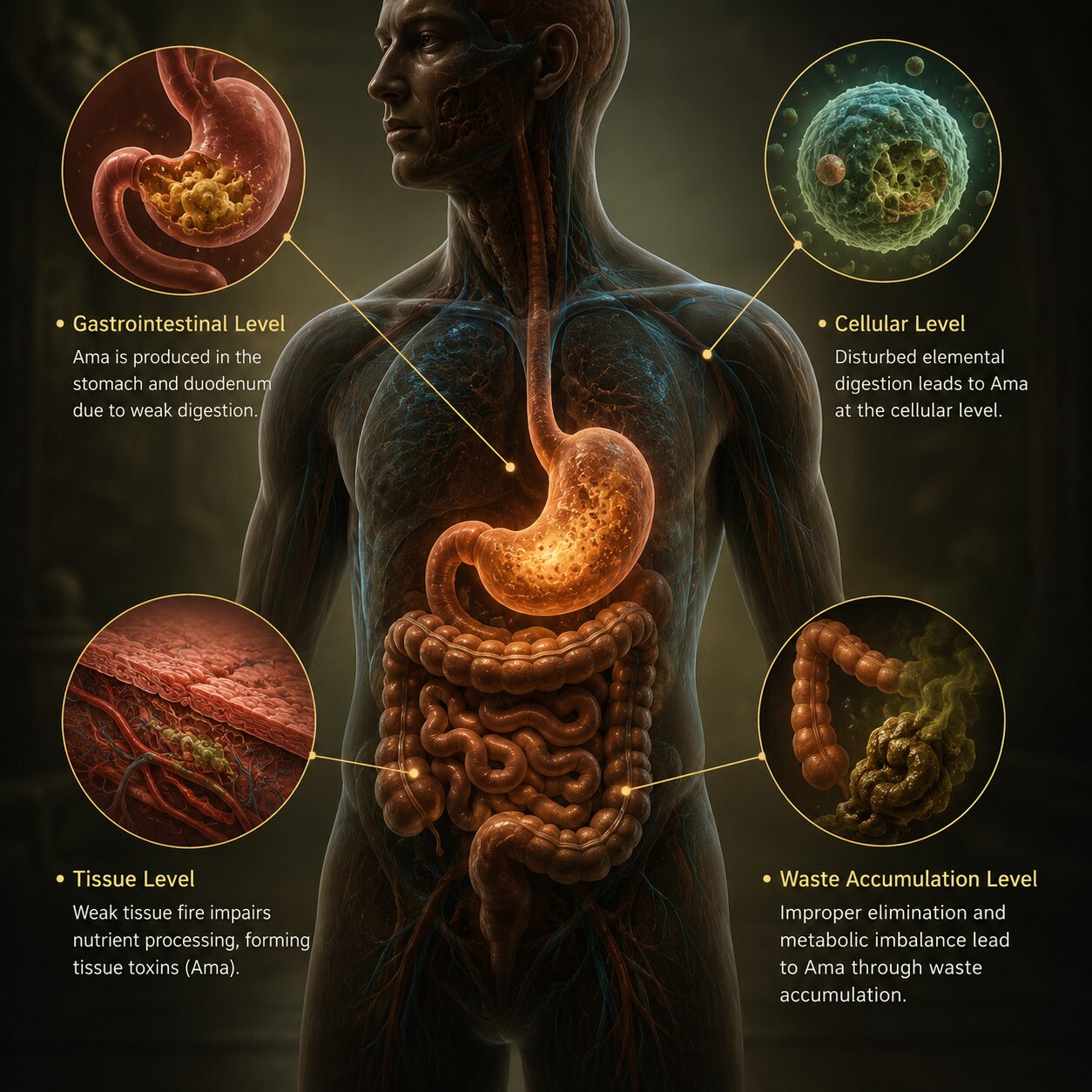
- Jatharagni-mandajanya Ama (Gastrointestinal level): This is the primary site of Ama production, occurring in the stomach and duodenum due to hypo-functioning of Jatharagni. It then ferments and forms a sticky, foul-smelling substance known as food toxin (Ama).
- Bhutagni-mandajanya Ama (Cellular Level):
After Jatharagni has functioned, the five Bhutagnis (elemental fires) act on the components of the food. If any disturbance occurs in Bhutagnis, subtle digestion (sukshma pak) fails, resulting in Ama at the cellular level. - Dhatvagni-mandajanya Ama (Tissue Level): Each of the seven dhatus (tissues) of the body has its own Dhatuvagni (tissue fire), which is responsible for processing nutrients to build different tissues. When Dhatuvagani is weakened, proper processing of nutrients is not possible, resulting in the formation of Dhatu Ama (cellular toxins) and Sama Dhatus (tissue-related ama).
- Mala Sanchaya Rupa Ama (Waste Accumulation Level):
Due to metabolic disturbances, the body cannot properly eliminate or utilise waste materials (faeces), which can lead to the formation of Ama, resulting in the accumulation of toxins.
Key Aspects of Ama Production at Different Sites:
- Aam is formed due to the weakening of Agni, and this accumulated Aam weakens Agni even further.
- Ama produced in the intestine circulates through the Rasa dhatu (plasma) and accumulates in areas of reduced function or obstruction, often causing joint pain or various skin problems.
- When Ama combines with Doshas, Dhatus or Malas, it makes them “Sama” (related to toxins), which causes inflammation and blocks the channels (Srotas) of the body.
- When Ama mingles with Doshas, Dhatus, or Malas, it makes them “Sama” (associated with toxins), leading to inflammation and blocking body channels (Srotas).
Common Symptoms of Ama:
- Thick white or yellow coating on the tongue.
- Feeling heavy, lethargic, or having mental fogginess.
- Foul smell from the mouth, sweat or stool.
- Stiffness in joints and pain throughout the body.
- Loss of appetite, gastric issues, indigestion and irregular bowel movements (constipation or diarrhoea).
- Lack of motivation and decreased mental clarity.
Guide to Cleansing of Ama:
Depending on the severity, quantity and type of Ama, a three-pronged approach is recommended to deal with Ama dosha.
- Laṇghana (therapeutic fasting/lightening therapy): Langhana involves restricting nutritional intake, including complete fasting, to give rest to the body’s digestive and metabolic systems. In this therapy, it is recommended to eat easily digestible foods like hot soup, broth or khichdi (rice and moong dal). It makes the body light by relieving heaviness.
- Laṇghana Pachana (therapeutic fasting with digestive herbs): Laṇghana Pachana also involves the use of active herbs, which digest and metabolise the Ama and render it inactive. Different medicines can be used depending on the type of Ama. In this therapy, various herbal remedies like ginger (Shunti), cumin, Trikatu, or Triphala to aid the Pachana (digestion of toxins).
- Sodhana (purification/detoxification therapy): Shodhana is a purification process that completely removes the Ama Dosha from the body. This includes Panchakarma procedures—specifically Vamana (emesis) or Virechana (purgation)—to treat deep-seated toxins.
At Vaidyaratnam Vrindavan Ayurveda Chikitsalayam, we use these three processes under the right circumstances that can help remove deeply ingrained toxins from the body. Along with various therapies, here we guide you on lifestyle, breathing exercises, meditation and various herbs that can support you in your journey towards health and wellness.
FAQ
Q1. What causes Ama to form?
Ama is a metabolic toxin and is formed when the digestive fire (Agni) is weak (Mandagni), so that food is not completely digested.
Q2. What is the relationship between ama and immunity?
Ama reduces ojas (the key element of immunity and stamina) in the body, making the body more susceptible to frequent illness and reducing its resistance to disease.
Q3. How to remove ama from the whole body?
Daily detox practices like eating light and freshly cooked foods, drinking cumin-fennel tea, oil massage, and getting enough sleep can gradually eliminate Ama.
Q4. Which foods produce Ama the fastest?
Cold, processed, heavy, or incompatible foods, such as fried dishes, refined sugar, milk with fruit, or overeating even when not hungry, weaken Agni and quickly lead to the formation of ama.
Q5. What are the first symptoms of Ama accumulation in the body?
A white coating on the tongue, feeling tired after meals, bloating, dull skin, and lack of motivation are all early signs that your body is filled with ama.