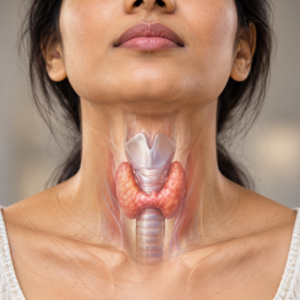
Transform Your Health Through Daily Practices
In today’s fast-paced world, we often ignore our health; it actually takes a backseat. Constant stress, workload, lack of time and irregular routines get added to that. All these things disrupt our body’s natural balance.
But what if the key to better health lies in something as simple as a daily routine?
Dinacharya is a traditional Ayurvedic form of daily routine. It offers you a powerful framework to align your body, mind and spirit with your biological clock. It is nature’s rhythm to balance your doshas. By adopting these time-tested daily practices, you can enhance your energy, improve digestion and build long-term wellness.
Dinacharya – Ayurvedic daily routine
Dinacharya is made up of two Sanskrit words, ‘din’ and ‘charya’.
- Din = Day
- Charya = Routine
When we translate this, it comes out as “daily routine”. Dincharya is a well-formulated set of habits designed to maintain balance. Following Dincharya provides you with a balance in your body’s biological energies.
Unlike modern routines driven by productivity alone, Dinacharya focuses on preventive healthcare. It encourages you to stay healthy in a complete manner. It creates a proper balance between your physical, mental and social well-being. Dincharya is a preventive measure rather than after care.
Key practices include waking before sunrise, tongue scraping, drinking warm water, oil massage (Abhyanga), yoga, meditation, and eating meals aligned with digestive strength.
Key Benefits of Dinacharya in Ayurveda
Balance Doshas
When you follow a consistent daily routine, it maintains all your doshas. Harmonic stability among Vata, Pitta, and Kapha allows you to lead a healthy life.
Improves digestion and metabolism
Ayurvedic daily regime supports your agni i.e. digestive fire. Better agni results in better digestion and assimilation. Dincharya keeps your digestion up to the mark.
Boosts immunity
If you follow dincharya rigorously, you’ll remain free of diseases. This helps in the removal of toxins from your body. Mild daily detoxification helps in boosting immunity and providing you with overall health.
Enhances Mental Function
Following a proper daily regimen sharpens your cognitive abilities. Daily yoga and meditation, along with Nasya, calms your mind. This strengthens your nervous system, promoting improved mental function and stress free mind.
Longevity
Daily Ayurvedic routine acts as a preventive medicine for your body. It gives you a long and healthy life. When your body is strong and healthy, you automatically remain healthy and happy.
By syncing your lifestyle with natural cycles, your body functions more efficiently and harmoniously.
The Ideal Ayurvedic Daily Routine
Dinacharya (Day routine)
Day routine is all about the regimen you have to follow in the morning. Precisely speaking, routine from waking up to 10 am in the morning. This is Kapha kala i.e., Kapha is dominant during this time period. Let’s see what we should do in this kapha kala -:
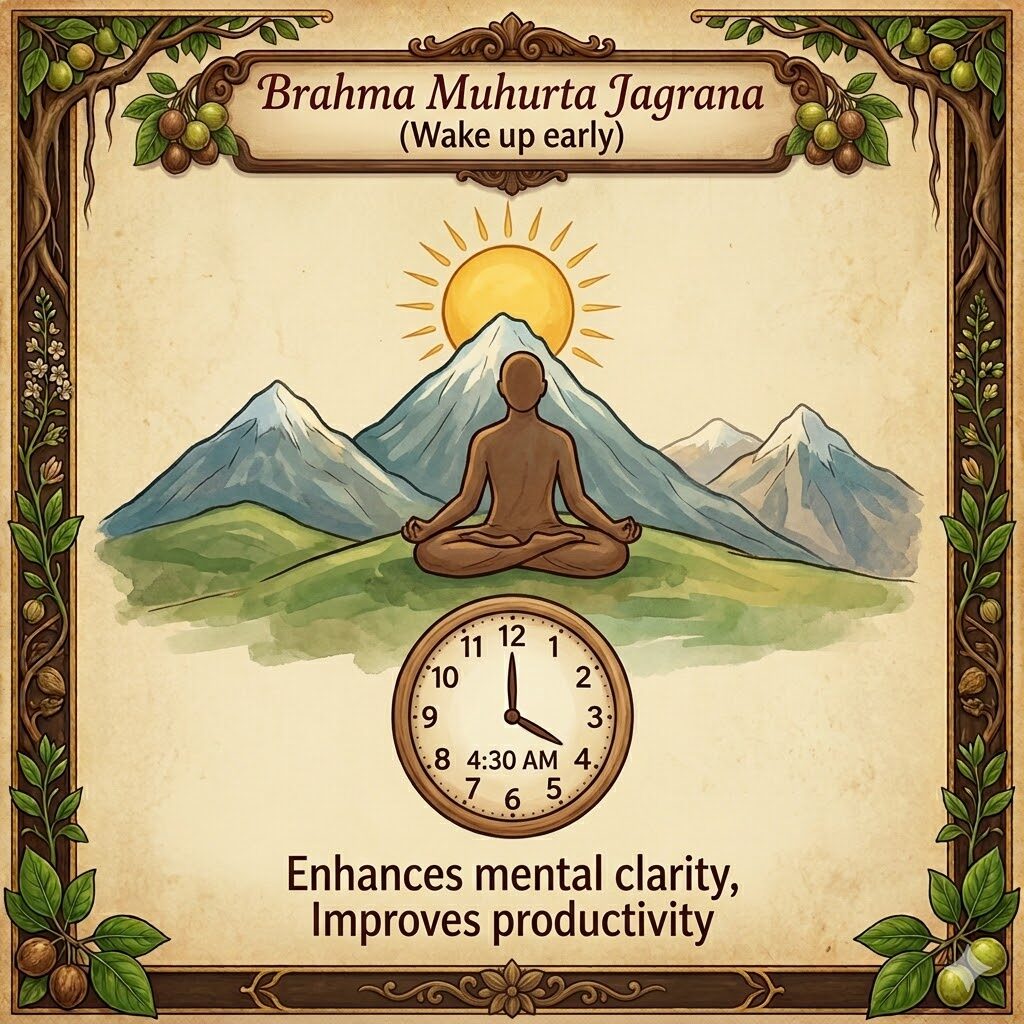
- Brahma Muhurta Jagrana (Wake up early):
You should wake up before sunrise (around 4:30–6:00 AM). This is considered as an ideal time to start your day. This time is calm, pure and filled with positive energy.
Benefits:
- Enhances mental clarity
- Improves productivity
- Supports spiritual practices
- Usha Jalapana (Water drinking):
Drink a glass of lukewarm water after getting free from daily chores. This should be done 45 minutes before sunrise i.e.,in Ushakala.

Benefits:
- Keeps you hydrated all day long.
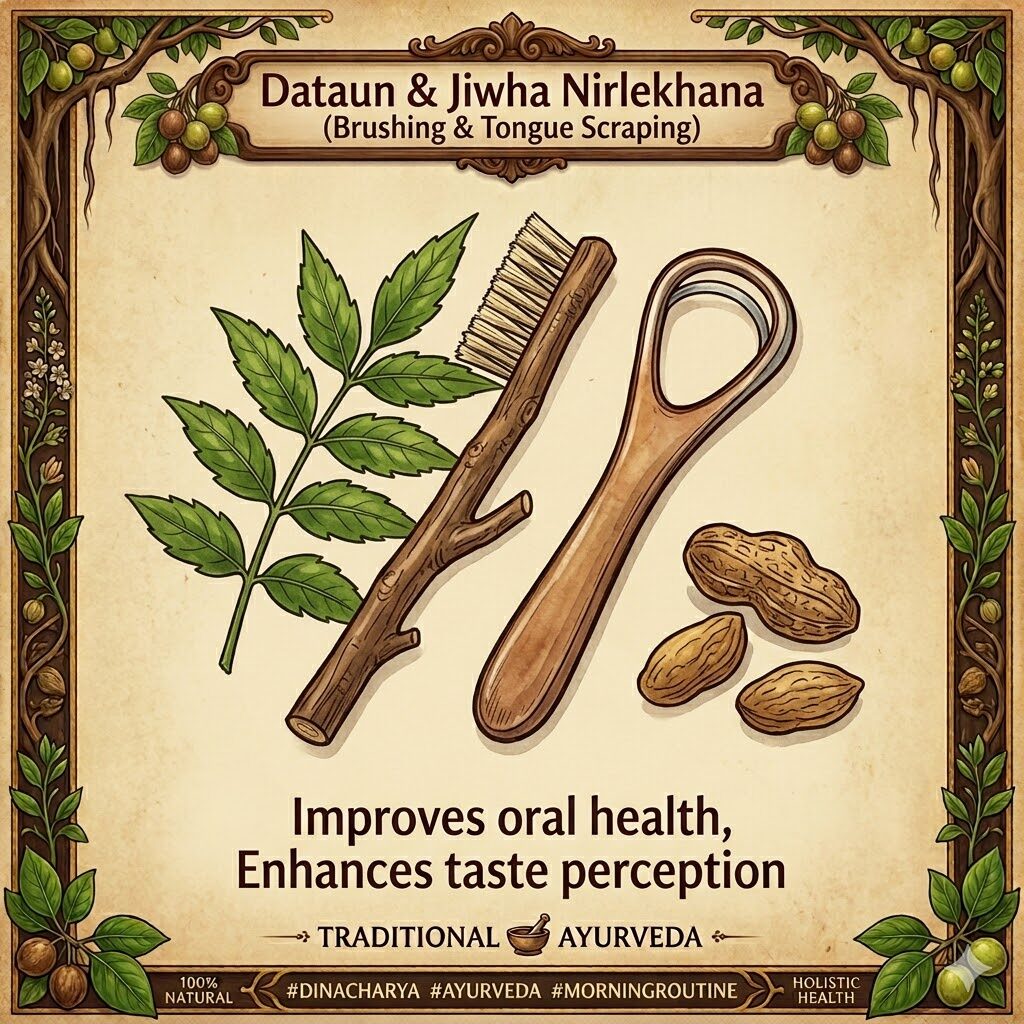
- Dataun & Jiwha Nirlekhana (Brushing & Tongue Scraping):
Start your day by cleaning your teeth using a dataun. Dataun should be as per your doshic build. You can use fresh twig of Neem, Karanja, Khadir etc. as dataun. After brushing, go for scraping your tongue. This whole oral routine removes toxins (aama dosha) that accumulate overnight in your oral cavity.
Benefits:
- Improves oral health
- Enhances taste perception
- Supports digestion
- Clears aama dosha (toxins)
- Gandusha (Oil pulling):
After cleaning your mouth, do oil pulling. You have to fill your mouth with slightly warm oil for 5–10 minutes. You can start with coconut or sesame oil or as per your dosha balance. This helps in removing toxins out of your oral cavity. Gandusha improves your oral health and gives strength to your teeth and gums.

Benefits:
- Strengthens gums and teeth
- Prevents bad breath
- Detoxifies oral cavity
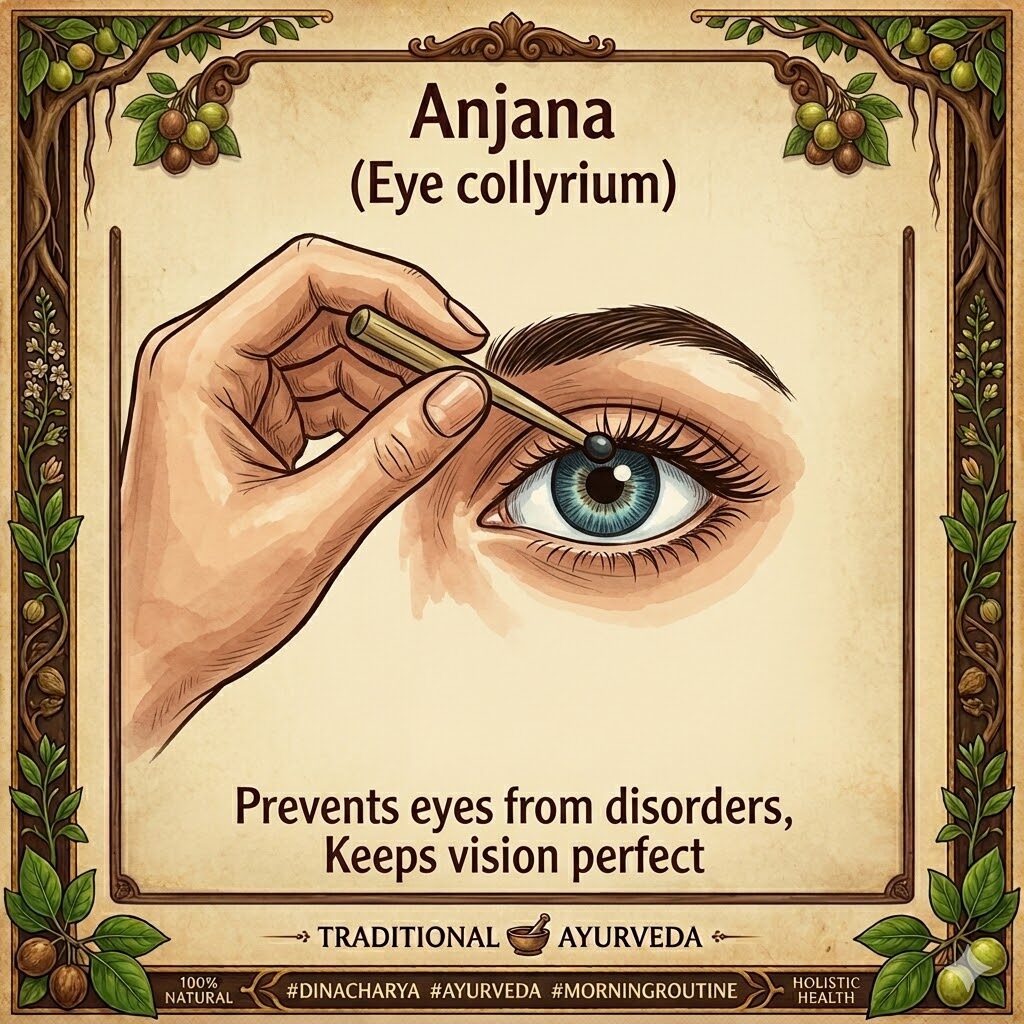
- Anjana (Eye collyrium):
There are five types of Anjana, as mentioned in Ayurvedic texts. Rasanjana, a mild form of medicated collyrium, you can apply it daily. Anjana is applied, as you apply kajal in your eyes. It clears your eyes of dirt and excess mucous. This also gives your eyes a lustre and strength.
Benefits:
- Prevents eyes from disorders
- Maintains Alochak pitta
- Keeps vision perfect
- Dhumpana (Medicinal smoking):
Dhoompana is not considered as a good habit now-a-days. However, medicinal smoking is mentioned in Ayurveda 5000 years ago. Medicinal cigarette is different than the usual one. It unlike modern day cigarette, does not harm your lungs. This can be made using haldi and gauge piece at home. You may use it daily or 1 – 2 times a week. The only rule is never expel out the smoke through your nose. Expel it only through your mouth. Otherwise, this may harm your senses.
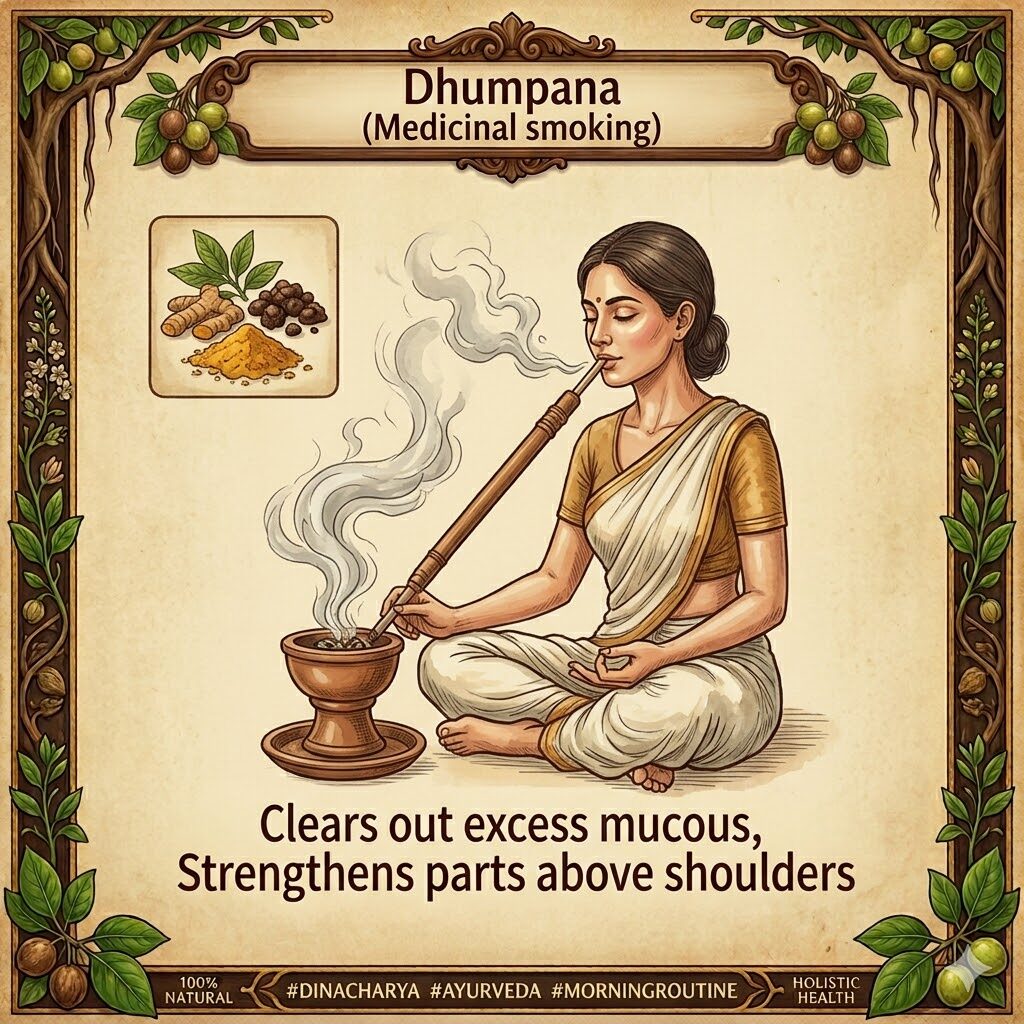
Benefits:
- Clears out excess mucous
- Strengthens parts above the shoulders
- Nasya (Nasal oil drops):
There are many types of Nasya according to the disease you may have. It is one of the parts of five Panchkarma processes. But, you can practice Pratimarsha Nasya daily in the morning. You can administer two drops of Anu oil/melted Goghrita in each of your nostrils.

Benefits:
- Promotes mindfulness
- Increases focus
- Prevents senses from ailments
- Abhyanga (Oil Massage):
Massage your whole body with warm medicated oil for at least 15 – 30 min. Choose your oil as per the dosha of your body. Warm oil massage reduces excess vata dosha. It nourishes your skin and calms your nervous system. Abhyanga is a must do before doing any exercise.

Benefits:
- Improves blood circulation
- Reduces stress and fatigue
- Provides soft and glowing skin
- Alleviates vata dosha
- Vyayama & Yoga (Exercise):
After doing self massage, engage in light exercise, yoga or stretching. This should primarily be based on your body type. Optimum amount is when you sweat or your breathing gets heavy.

Best Practices:
- Practice yoga or Surya Namaskar
- Include breathing exercises (Pranayama)
Benefits:
- Boosts energy
- Enhances flexibility
- Supports mental well-being
- Strengthens body
- Tightens muscles
- Snana (Bathing):
Take a warm or cold bath according to your prakruti (body type). Or you can choose the warm or cold water according to your dosha imbalance. Bathing refreshes your body and mind, removing fatigue. It prepares you for the day ahead.
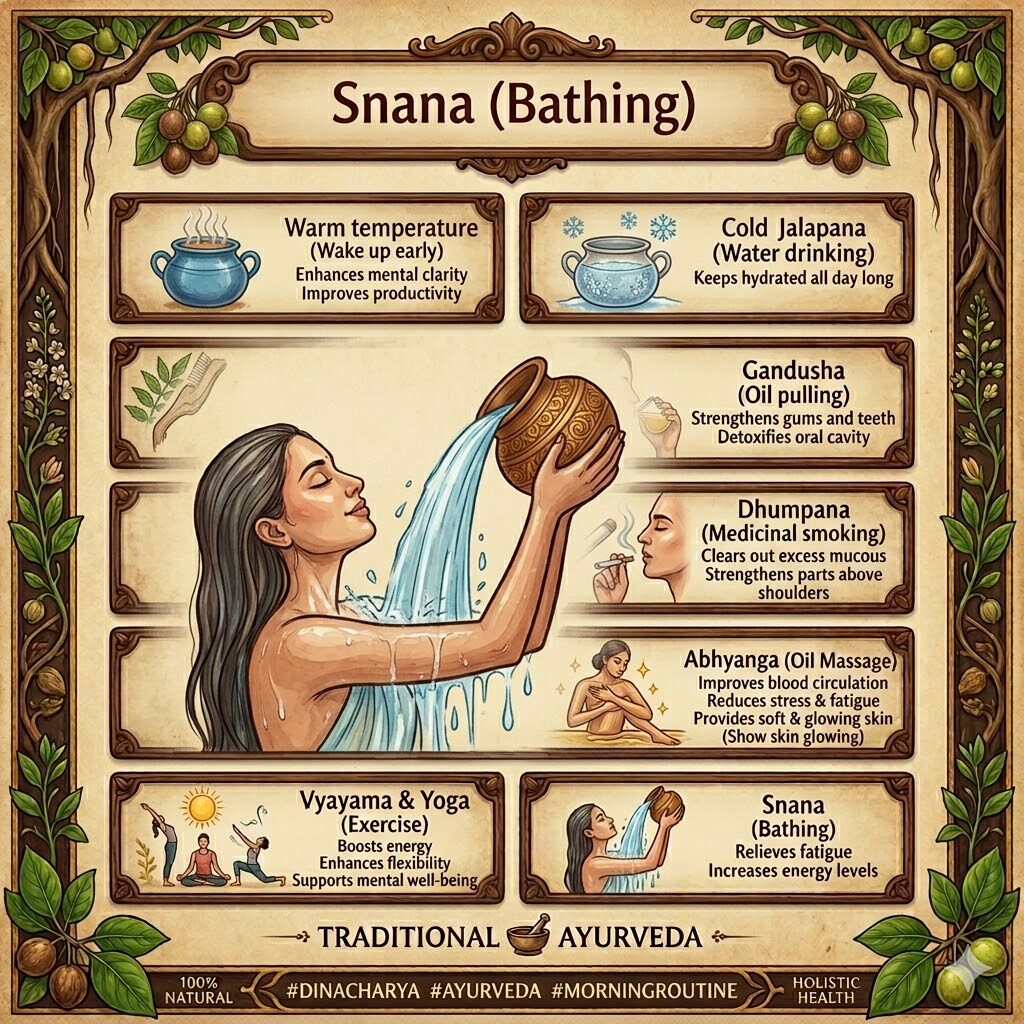
Benefits:
- Relieves fatigue
- Increases energy levels
- Clears out the excess sweat and dirt
Madhyahnacharya (Afternoon routine)
Madhyahna kala is afternoon. It starts after 10 am and lasts upto 2pm. In this kala, Pitta is the dominant dosha. This is the time when you get hungry and have your lunch. After doing all the chores of the morning and doing some work, it’s tummy time.
Guidelines:
- Eat your lunch around 12pm – 1pm,
- Have meals on regular times and focus on fresh, wholesome foods.
- Avoid overeating
- Eat in a calm environment
- Include all six tastes (sweet, sour, salty, bitter, pungent, astringent)
Sayamcharya (Evening Routine)
This time is from 2pm to 6 pm in the evening. In this time period, vata dosha is most powerful. So, as the day ends, slow down your activities.
There are also some not do list in the evening, specially when the sun is setting down:
- Don’t eat food
- Don’t sleep
- Don’t study
- Don’t engage in intercourse
- Don’t go for a walk
Ratricharya (Night routine)
Ratri starts after the sun sets i.e. from 6pm to 10pm. In this time period, above cycle of doshas repeat itself. In this kala, kapha is dominant again, as it was in the morning time. The same cycle goes through the night. After this, there is pitta kala and then, vata dominant kala.
Suggestions:
- Eat a light dinner around 7pm
- Avoid screens before bed
- Practice meditation or deep breathing
- Going to bed by 10 PM
Benefits:
- Supports hormonal balance
- Improves skin and immunity
- Enhances mental clarity
- Rejuvenates and revives body and mind
Tips to Start Dinacharya in Modern Life
Adopting a full routine overnight can be overwhelming. So, start small, take little steps every day and you’ll get addicted to this routine in a few days. It’s is better to start small than not starting at all. Here are some tips that you can follow:
- Wake up 15 minutes earlier each day
- Introduce one new habit at a time
- Stay consistent rather than striving for perfection
- Listen to your body’s needs
Start your Dinacharya today and take your first step toward a healthier and perfectly balanced life.
Final thoughts
Dinacharya is an ancient way of living life as per Ayurvedic wisdom. It is still relevant in today’s world. Many of Dincharya’s principles are supported by today’s researches. Modern concepts like circadian rhythm, mindful eating and sleep cycle closely resemble Ayurvedic daily regimen. This shows that traditional Ayurvedic practices are highly aligned with the understanding of human biology.
Dincharya is a “well proven science” of living your life. This holistic lifestyle synchronizes your body and mind with nature. Dincharya improves your digestion, improves mental health and enhances your immunity. By aligning your daily activities with Ayurvedic principles, you can achieve overall wellbeing. In a world where stress and imbalance are common, this ancient wisdom offers a roadmap to vitality, longevity and inner peace. Start today and let your daily routine become your most powerful weapon towards a healthy life.
Frequently Asked Questions (FAQs)
How can I start Dinacharya, if I have a busy schedule?
How much time does Dinacharya take to show its benefits ?
Can children and elderly people follow Dinacharya ?
Is Dinacharya only about physical health?
References
- Applied aspects of Dincharya – The Daily Regimen as per Ayurveda, directing towards health maintenance and disease prevention in present era by Sheetal Asutkar, Yogesh Yadav, and Vasudha Asutkar
https://www.ijam.co.in/index.php/ijam/article/view/3578
- Role of Dinacharya (daily routine) in the prevention and management of obesity: A narrative review by Tyagi Pallavi, Shirkande Abhijeet, Londhe Nilesh, and Londhe Sarika
https://journals.lww.com/jdra/fulltext/2025/11002/role_of_dinacharya__daily_routine__in_the.12.aspx
- ROLE OF DINCHARYA IN THE MANAGEMENT OF LIFESTYLE DISORDERS by Dr. Janki Bopaliya, Dr. Vaidehi Raole, and Dr. Disha Soriya
https://ierj.in/journal/index.php/ierj/article/view/2935
- Scientific approach towards Dincharya – A Review by R. Kapse, Dewangan B, Solanki A, Sinha R, Parveen Y, Kumar P, Marapi B, Kande A.
https://jaims.in/jaims/article/view/2478/3360
- Dinacharya and Stress Management: A Preventive approach by Dr. Sonali Jagdale and Dr. Smita Dhurde