Do you often feel stressed, low on energy or struggling with mood swings?
Or you lose focus easily, or you struggle with a weakened immune system?
Are you a male with low stamina or a female with a An adaptogen hormonal imbalance?
Then, there is a perfect solution for you – Ashwagandha.
Ashwagandha is a powerful adaptogenic herb with immense benefits. It helps you feel calmer, stronger, and more balanced. People have used this classic herb for centuries. It helps restore energy, reduce stress, and boost overall well-being.
Let’s explore everything you need to know about this magical remedy.
Let’s discover the benefits of Ashwagandha, an Ayurvedic herb, how it works, what it does, and whether it’s actually worth adding to your routine.
What is Ashwagandha?
“Ashwagandha”, as the name suggests, translates to “smell of a horse”. The roots of the Ashwagandha plant have a peculiar smell, similar to that of a horse. This symbolises its benefit of imparting to you the strength and stamina same as that of a horse. It is commonly called Indian ginseng. However, it does not belong to the ginseng family. Its roots are widely used in traditional Indian medicine, in both Ayurveda and the Unani system.
In Ayurveda, this herb is classified as a Rasayana and Vajikarana. Rasayana refers to any herb or formulation that rejuvenates your body and mind. Rasayana benefits you by delaying the ageing of your body and promoting longevity and vitality.
Vajikarana, an Ayurvedic term for aphrodisiacs, is the quality of a herbal formulation that imparts to you the stamina same as that of a horse. Ashwagandha is also famous for its quality as an adaptogen. An adaptogen is a compound or product that increases your body’s ability to resist and adapt to stressors, either mental or physical.
Ashwagandha – Introduction and Medicinal Qualities
Scientific name – Withania somnifera
Family – Solanaceae
Chemical composition – withaferin, withanone, withanolide, somnirol, somniferin, somnitol etc.
Rasa – Katu (pungent), Tikta (bitter), Kashaya (astringent)
Guna – Snigdha (unctuous), Laghu (light)
Virya – Ushna (hot potency)
Vipaka – Madhura (sweet after digestion)
Dosha – Tridosha shamak
Top Health Benefits of Ashwagandha in Ayurveda

Reduces Stress and Anxiety
Ashwagandha has the ability to lower cortisol levels, the stress hormone. Cortisol levels increase when you are exposed to continuous stress. Its adaptogenic quality allows it to reduce symptoms of anxiety and stress. When you use it regularly, it elevates your mood and promotes emotional balance.
Boosts Energy and Stamina
Ashwagandha is balya in nature, i.e., it provides you strength. It enhances your energy levels and stamina when used properly. It enhances endurance and physical performance by providing strength to all tissues of your body. This makes it a popular supplement among athletes.
Improves Sleep Quality
Ashwagandha has a calming effect on your nervous system. This quality of Ashwagandha helps it to improve your sleep cycle. In addition to this, it promotes deeper and more peaceful sleep.
Enhances Brain Function
Ashwagandha has been shown to improve brain functioning. It enhances your memory, focus, and cognitive ability. It does this through its property of reducing oxidative stress.
Supports Hormonal Balance
Ashwagandha also works as a hormone regulator agent. It acts directly on the centres of your brain and maintains hormonal levels. It is often used to support thyroid function. It helps in managing conditions like PCOD and other related issues. This in turn improves fertility in women.
Strengthens Immunity
Ashwagandha is an immuno-modulatory agent. It modifies your immune system to perform more efficiently. It enhances the production of immune cells to provide you with a stronger immune response. It is highly packed with antioxidants. This property helps in eliminating the free radicals present in your body.
Controls Blood sugar
Ashwagandha is said to possess glucose lowering property. When used wisely, it may manage your blood sugar level. Its hypoglycaemic action is supportive in managing Type 2 Diabetes.
Anti-inflammatory Effects
Ashwagandha has anti-inflammatory properties. It helps reduce inflammation found in arthritis and other inflammatory conditions. It acts on inflammatory mediators reducing the inflammation.
Useful in male infertility
Ashwagandha is Vrishya in nature as discussed above. It improves your testosterone levels through its hormone balancing quality. In turn, both the quality and quantity of your sperm gets improved. Thus, Ashwagandha is very much helpful in treating male infertility.
Uses of Ashwagandha
Ashwagandha is a widely used herb in Ayurveda. It is known for its adaptogenic properties. Additionally, Ashwagandha has multiple benefits. Here are its main uses:
- Aphrodisiac
- Weak immunity
- Low body weight
- Debility
- Emaciation
- Insomnia
- Depression
- Stress
- Anxiety
- Leucorrhoea
- Numbness
- Diabetes
- Hypertension
- Hypothyroidism
- Erectile dysfunction
- Hormonal imbalance
- Tinnitus
- Vitiligo
- Wound healing
How Ashwagandha Works – Mode of Action

Ashwagandha is Ushna (hot potency) and Snigdha (unctuous) in nature. It balances all three doshas, specifically the Vata and Kapha doshas. Somniferin, an active chemical compound, is well known for its sedative and anxiolytic action.
This proves its efficacy in managing insomnia, stress, and anxiety. Adaptogens, such as Ashwagandha, stabilise your body’s functions.
They promote homeostasis. This means your body becomes more tolerant to stress, whether it is physical fatigue or emotional pressure. Ashwagandha stimulates the thyroid gland, thus improving the secretion of thyroid hormones, providing relief in hypothyroidism. It has antioxidant and hypoglycemic properties.
Ashwagandha works holistically on every system of your body, rather than acting on a single target. It very well balances your nervous system, endocrine system, and immune function.
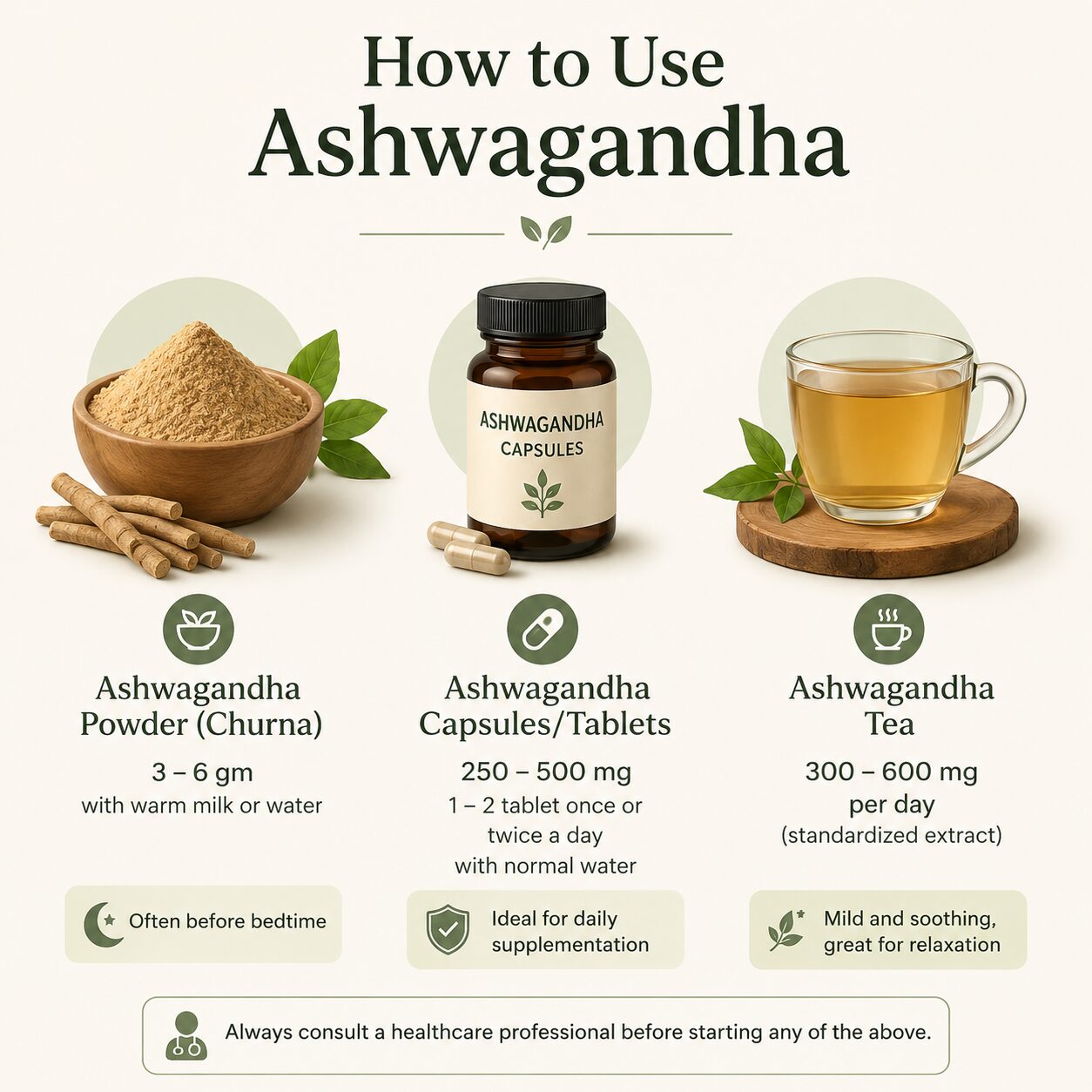
How to Use Ashwagandha – Dosage and Preparations
- Ashwagandha Powder (Churna)
3 – 6 gm, traditionally mixed with warm milk or water
Often consumed before bedtime
- Ashwagandha Capsules/Tablets
250 – 500 mg, 1 – 2 tablet once or twice a day with normal water
Ideal for daily supplementation
- Ashwagandha Tea
300–600 mg per day (standardized extract)
Mild and soothing, great for relaxation
Always consult a healthcare professional before starting any of the above.
Potential Side Effects
While generally safe, Ashwagandha may cause:
- Mild digestive upset
- Drowsiness
- May worsen gastritis
Avoid if:
- Pregnant or breastfeeding
- Having digestive issues
- Taking sedatives
- On thyroid medication
- Undergoing any long-term treatment
Conclusion
Ashwagandha is truly the most powerful adaptogenic herb in Ayurveda. This ancient remedy can help reduce stress, boost immunity, and improve overall health. It offers a natural and effective solution.
Ashwagandha has gained massive popularity as a herbal supplement in the global wellness industry. In today’s time, many scientific studies have proven its efficacy in various aspects of daily life. It is a bridge between ancient wisdom and modern science.
Adding Ashwagandha to your daily routine can boost your physical and mental well-being. It’s a bold step that may lead to positive changes.
FAQs
- How much time does Ashwagandha take to show its effect?
Most people notice benefits within 2–4 weeks of consistent use. - Can I take Ashwagandha daily?
Yes, it is generally safe for daily use when you take it in recommended doses. Better to consult an Ayurvedic doctor for long-term use. - Is Ashwagandha safe for everyone?
Ashwagandha is safe for most of us. However, consult a Vaidya if you have any medical condition or are on medication.
Research corner
- Ashwagandha (Withania somnifera) helps treat and improve mental and physical health. This is based on a systematic review of human trials by Adrian L. Lopresti and Stephen J. Smith.
https://www.sciencedirect.com/science/article/abs/pii/S2210803321000142
- An investigation into how ashwagandha (Withania somnifera) extract helps relieve stress and its effects on health.
A randomized, double-blind, placebo-controlled study by Adrian L.Lopresti, Stephen J.Smith, Hakeemudin Malvi, Rahul Kodgule
- The therapeutic potential of Withania somnifera (Ashwagandha) is explored in this review. It covers its phytochemical properties, pharmacological effects, and clinical uses. Authors include Martina Martorana, Anastasia Valentina Liga, and Fabio Venturella.