Have you ever wondered why your body doesn’t behave the same way all year round?
Why are there shifts in your appetite as the season changes?
Why do your cravings change with the weather?
Why are some food items available in a season but not in another?
Do you observe changes in your sleep patterns with shifting weather?
Have you ever thought that there are different regimens for different seasons?
This is what Ritucharya is.
Why Seasonal Living Matters?
As seasons change, temperature and humidity shift. This affects digestive strength and immunity. As the seasons change, people change too. Humans are a key part of this ecology. Ignoring these changes can lead to fatigue, digestive issues, and seasonal illnesses.
In this blog, we’ll explore the definition and benefits of Ritucharya. We’ll also look at seasonal rituals to follow throughout the year.
Ritucharya in Ayurveda
Ritucharya is an Ayurvedic concept that refers to “seasonal regimen.” These are the rituals and habits you follow during various seasons and their transitions. It guides us in aligning seasonal transitions with our diet, lifestyle, and daily habits to maintain balance in the body and mind. Adaptations according to the changes is the key for survival.
Ayurveda is built on the principle that human health and Mother Nature are deeply connected to each other. Ritucharya guides you to stay in sync with nature. It is a guideline to follow in all seasons for a smooth transition from one season to another without falling ill.

Two Divisions of a Year
Ayurveda divides the twelve months of a year into two major parts – Adana Kala and Visarga Kala. These two kalas describe the changes in nature and their effects on the human body.
Adana kala (Northern Solstice Phase/Uttarayan)
Adana Kala is the time period marked by a gradual increase in the sun’s energy. This growing energy draws strength from living beings and the environment. It results in decreasing strength and increasing dryness in both living beings and the environment.
From the middle of January to the middle of July.
Includes three seasons:
- Shishira (Late winter) – mid January to mid March
- Vasanta (Spring) – mid March to mid May
- Grishma (Summer) – mid-May to mid July
Characteristic features:
- Heat and dryness increase
- Gradual loss of Bala (strength)
- Dominance of bitter, astringent, and pungent tastes
- Gradual decrease in digestive power
Visarga Kala (Southern Solstice Phase/Dakshinayan)
Visarga Kala is the time period of six months, when the moon’s energy increases and the sun’s energy decreases. This results in nourishment of the environment and restoration of lost energy.
Time period – mid July to mid January
Includes three seasons:
- Varsha (Monsoon) – Mid- July to Mid-September
- Sharad (Autumn) – Mid-September to mid-November
- Hemanta (Early winter) – Mid-November to Mid -January
Characteristic features:
- Dryness decreases and moisture increases
- Gradual gain of strength (Bala) in humans
- Body regains its lost strength
- Digestive power improves
Key Differences in Adana and Visarga Kala
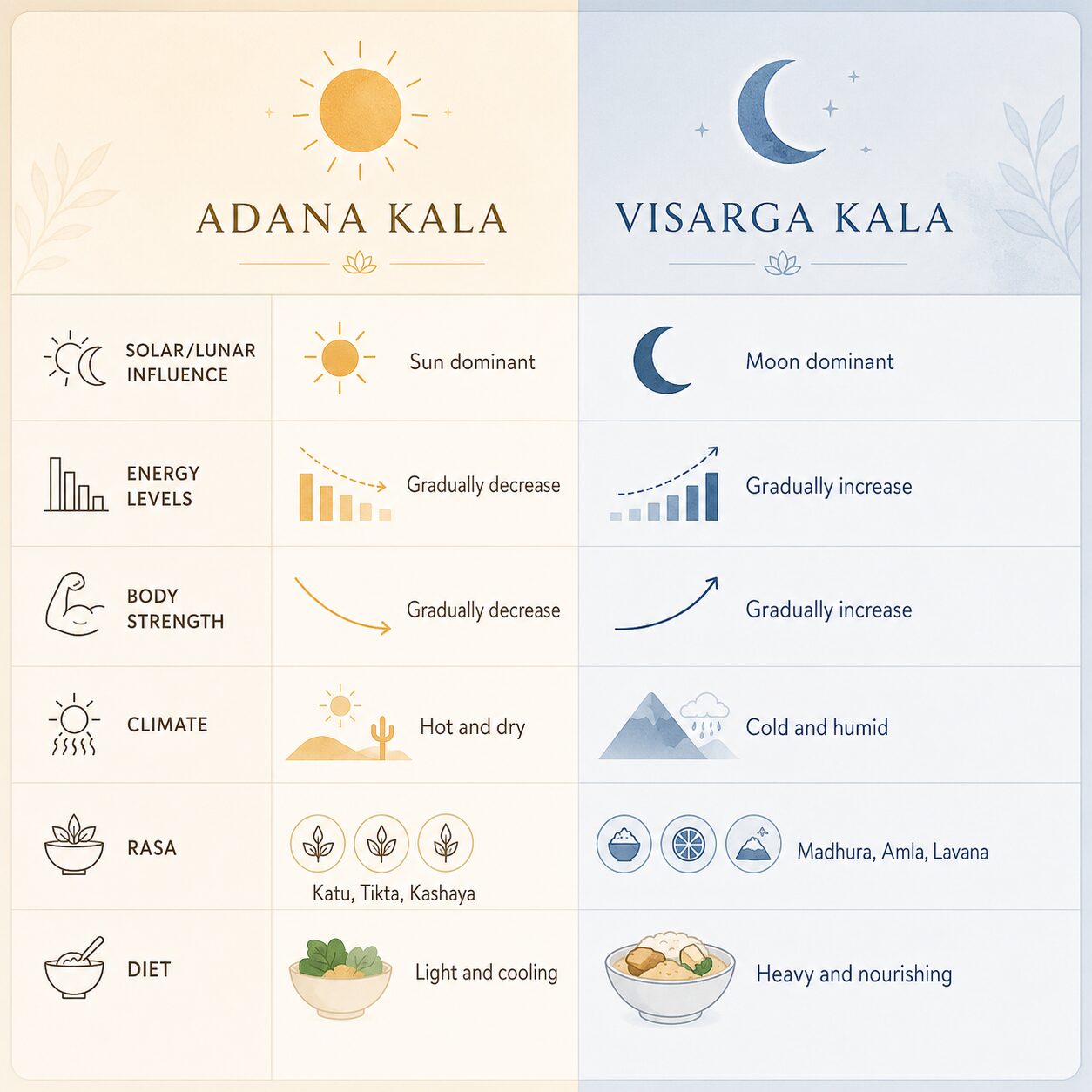
Adana Kala
Visarga Kala
Solar/Lunar influence
Sun dominant
Moon dominant
Energy levels
Gradually decrease
Gradually increase
Body strength
Gradually decrease
Gradually increase
Climate
Hot and dry
Cold and humid
Rasa
Katu, Tikta, Kashaya
Madhura, Amla, Lavana
Diet
Light and cooling
Heavy and nourishing
Seasonal Regimens
Hemant Ritu (Early Winter)
Characteristics:
- Cold climate
- Strong digestive fire
- Increased appetite
- High energy levels
- Maximum strength and immunity
- Moon is in maximum power
- Dominant rasa – Madhura (Sweet)
Dietary requirements:
- Have unctuous, salty, sour food items
- Eat nutrient-dense foods – Nuts, Dairy, Whole grains, Meats, Jaggery, new rice
- Have healthy fats and warm meals
- Have ginger, garlic, pepper
- Drink warm water
Lifestyle Tips:
- Exercise regularly
- Oil massage (Abhyanga)
- Stay warm
- Sun exposure
- Wear warm clothes
- Ideal for intercourse
What to avoid:
- Light food
- Cold breeze
- Less meal
- Sattu
Shishir Ritu (Late Winter)
Characteristics:
- Colder than Hemant ritu
- Dryness increases in the environment
- Rains and raindrops are there
- Dominant rasa – Tikta(bitter)
Diet & Lifestyle:
Similar to Hemant Ritucharya.
What to avoid:
- Excessive cold exposure
- Katu(pungent), Tikta(bitter), and Kashaya(astringent) rasa
- Cold food items
Vasant Ritu (Spring)
Dosha: Kapha Prakopa
Body Condition: Accumulated Kapha from winter melts, causing heaviness
Characteristics:
- Medium strength
- Weak digestive fire
- Heaviness and sluggishness in the body
- Dominant rasa – Kashaya (astringent)
Dietary recommendations:
- Easily digestible food
- Old barley, Wheat, rice
- Honey
Lifestyle Tips:
- Exercise (Vyayama)
- Dry massage (Udvartana)
- Herbal smoking (Dhoomapana)
- Luke warm water after defecation
Grishma Ritu(Summer)
Characteristics:
- Heat increases in the environment
- Dryness enhances
- Energy decreases
- Digestion weakens
- Dominant rasa – Katu(pungent)
Dietary recommendations:
- Sweet, unctuous, and cooling foods – sattu, cow’s milk, ghee, old rice, sugar
- Stay hydrated
- Fruit juices, Shikanji, Aam panna
Lifestyle Tips:
- Stay indoors in cool environment
- Practice calming activities like meditation
- Apply sandalwood paste over body
- You can sleep during the day.
What to avoid:
- Lavana(Salty), Amla(sour), and Katu(Spicy) food
- Alcohol
- Exercise and intercourse
- Sun exposure
Varsha Ritu (Monsoon)
Dosha: Vata Prakopa
Characteristics:
- Digestive fire is weak
- Body’s strength is low
- Increased risk of infections
- Dominant rasa – Amla(Sour)
Dietary recommendations:
- Tridosha shamka food
- Unctuous, salty, and sour food
- Whole grains – wheat, barley, aged rice, soups
- Honey – must use in all food items
Lifestyle Tips:
- Drink boiled or filtered water
- Keep surroundings dry and clean
- Dry/oil massage(Udvartana)
- Fumigation of living spaces
What to avoid:
- Sattu
- Daytime sleep
- Sleeping under the dew
- Contaminated water and food
- Physical activities and intercourse
- Sunlight
Sharad Ritu (Autumn)
Dosha: Pitta Prakopa
Characteristics:
- Body’s strength is medium
- Digestive fire has medium power
- Dominant rasa – Lavana(salty)
Dietary recommendations:
- Sweet, bitter, light, and cooling food items
- Wheat, barley, red rice
- Ghee in moderation
Lifestyle tips:
- Moonlight walks
- Apply sandalwood paste
- Have water purified by sun and moon rays
What to avoid:
- Fats, oil, fish, curd
- Night dew
- Air breeze
- Alkaline foods
- Daytime sleep
Panchakarma and Ritucharya
Practitioners perform seasonal detoxification using Panchakarma therapies. As explained in Ayurveda, there is an accumulation of doshas in your body according to the season. This accumulation peaks in different seasons. This seasonal detox is performed during the season in which there is prakopa of that particular dosha. It is performed in healthy or diseased individuals to remove excess dosha.
Vasanta ritu – Vamana karma (Emesis therapy) for excess Kapha dosha
Sharad ritu – Virechana karma (Purgation therapy) for increased Pitta dosha
Varsha ritu – Basti (Enema therapy) for morbid Vata dosha
Benefits of Following Ritucharya
- Better digestion
- Strong immunity
- Improved mental clarity
- Reduced seasonal illnesses
- Natural weight balance
- Prevents lifestyle disorders
Final Thoughts
Ritucharya is not only about strict rules. It is also about alignment with environmental changes. When you start living with the seasons instead of against them, your body naturally finds balance.
Ritucharya teaches us to live in proper sync with the cycles of nature. By understanding seasonal cycles, we can maintain a harmonious relationship between our body and mind. When we adjust our diet and lifestyle according to dosha variations, we can maintain physical, mental, and spiritual health.
Ritucharya is a timeless Ayurvedic wisdom that is highly relevant in today’s life, as lifestyle disorders are increasing at a very fast pace.
Nature already knows what your body needs – Ritucharya simply helps you listen.
Commonly Asked Questions (FAQs)
1. How does Ritucharya prevent diseases?
When you follow Ritucharya, it maintains a balance between Vata, Pitta, and Kapha. An imbalanced Tridosha is the root cause of most of the disorders.
2. Can Ritucharya improve my immunity?
Yes, seasonal adaptation strengthens your digestion (Agni). Better Agni results in better immunity, reducing risk of illnesses.
3. Is Ritucharya feasible in modern times?
Absolutely. Even small adjustments like seasonal mindful eating, proper sleep timings, avoiding certain habits can have noticeable benefits on your health.
4. Do I need to consult an Ayurvedic doctor to follow Ritucharya?
Not necessarily for basic practices. But personalised guidance according to your prakruti is helpful if you have health conditions.
5. Is Ritucharya the same for everyone?
General guidelines are universal, but there may be slight adjustments depending on your Prakriti (body constitution) and health status.
6. When should I start following Ritucharya?
Anytime! Ideally, you should start at the beginning of a new season, but you can begin gradually at any point.
7. How to change from one regimen to another when the season changes?
The last 7 days of a season and the first 7 seven days of the adjacent season is the transitional phase. Gradually leave the regimen of the previous one and adapt to the successor’s.