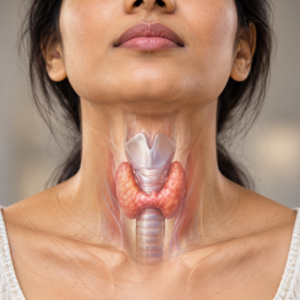
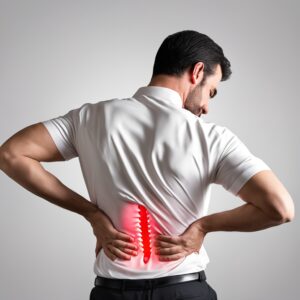
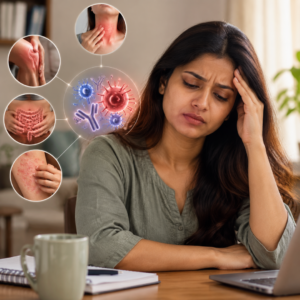
A Quick Self-Check Guide
Answer these:
✔ Do you often feel stressed or anxious?
✔ Is your skin dry or dull?
✔ Do you have body stiffness or poor sleep?
✔️ Does your body remain lethargic?
✔️ Do you often have pain in your joints?
✔️ Do you have a crackling sound in your joints?
If you said YES to 2 or more, Abhyanga can be a game-changer for you.
What is Abhyanga?
Abhyanga, also called Abhyangam, is a traditional Ayurvedic therapy. It uses a massage with warm herbal oils. These oils are medicinal and soothing. It is more than a massage; it is a therapeutic ritual mentioned by Acharyas to revive the energy of your body and mind.
In Ayurveda, practitioners recommend Abhyanga as a part of your daily routine (Dinacharya). When you practice abhyanga daily, it promotes longevity and prevents you from many diseases. It relaxes your mind, nourishes your skin cells and detoxifies your body. It is a powerful tool to counter your elevated vata dosha, As oils are the best medicine to alleviate vata dosha. What could be better than a warm oil massage?
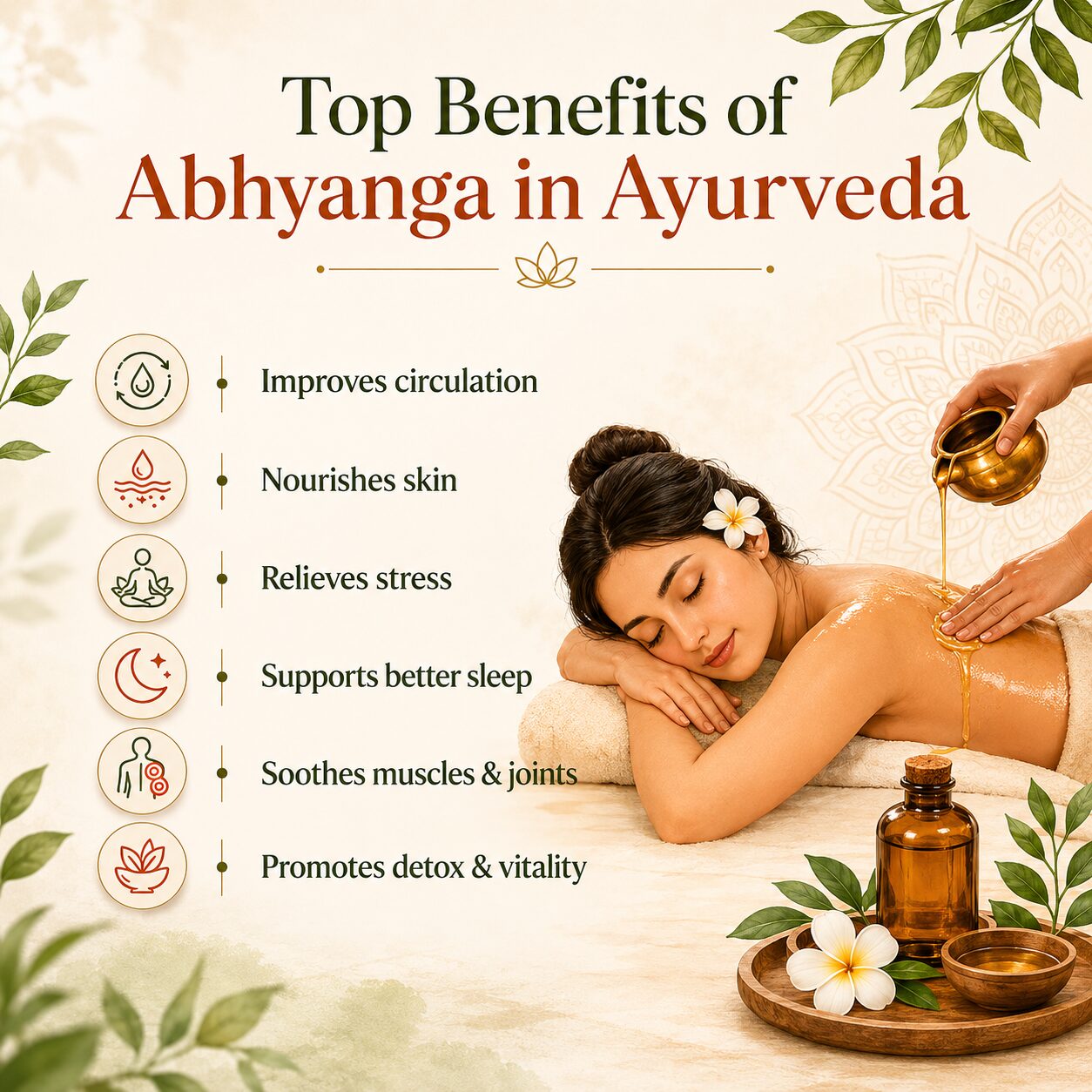
Top Benefits of Abhyanga in Ayurveda
Deep Relaxation & Stress Relief
The warmth of oil and the technique used for abhyanga calm your nervous system. Thus, helping reduce anxiety, stress and mental fatigue. This relaxes your mind and soothes your body.
Detoxification
Abhyanga, through its unctuous property, dissolves aama dosha present in your bodily channels. This dissolved aama dosha enters your gut and is then removed through the closest route.
Nourished & Glowing Skin
Abhyangam oil goes deep into your skin, providing nourishment and strength to tissues. It deeply hydrates your skin and improves its elasticity. Regular oil massage delays your ageing and provides you with glowing and healthy skin.
Better Blood Circulation
Abhyanga uses specific stroke techniques, like upward and circular motions. These techniques help improve blood circulation in your body. This also aids proper lymphatic drainage.
Joint & Muscle Strength
Abhyanga reduces tension and stiffness in your muscles. It increases joint mobility and relieves pain by lubricating them. When you do Abhyanga daily, it strengthens your joints and muscles.
Improved Sleep Quality
Abhyanga relaxes your body and mind. This improves the quality of your sleep. Better sleep leads to an energetic day and a peaceful mind.
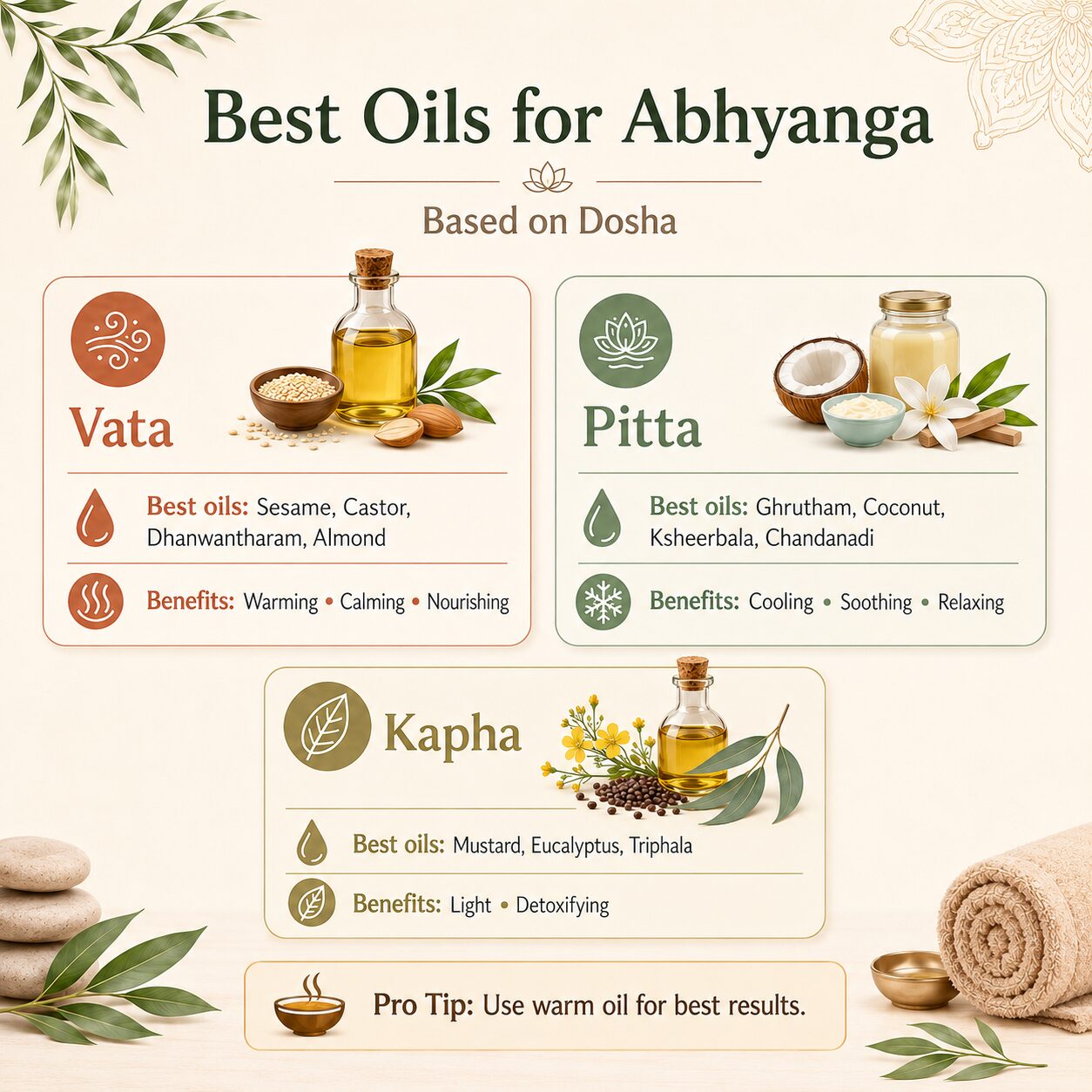
Best Oils for Abhyanga (Based on Dosha)
Choosing the right oil for therapy is the key to maximising benefits and gmaximisinget the desired results out of it :
Vata
Best oils: Sesame oil, Castor oil, Dhanwantharam oil, Almond oil
Benefits: Warming, Calming, Nourishing
Pitta
Best oils: Ghrutham, Coconut oil, Ksheerbala oil, Chandanadi oil
Benefits: Cooling, Soothing, Relaxing
Kapha
Best oils: Mustard oil, Eucalyptus oil, Triphala oil
Benefits: Light, Detoxifying
Pro Tip: Always use oil that is warm to achieve the best results.
How does Abhyanga work?
Abhyanga works on many levels when you get it done in the correct way. Abhyanga works on each and every cell of your body by nourishing it and removing toxins (Aama dosha). It balances raised Vata dosha through its oily and warm nature, as these qualities are opposite to the guna of Vata dosha. Abhyanga increases blood circulation, channelizes lymphatic drainage by removing the blockage.
Abhyanga is defined as Purvakarma (Preparatory process) done before the major Panchkarma process Vamana, Virechan and Basti. This procedure liquefies toxins present in your body’s channels and moves them to the gut for elimination. Abhyanga does all these things while relaxing your neuromuscular system.
- Physical: Boosts blood flow, nourishes tissues and cells, opens tiny channels, and relaxes tight muscles.
- Mental: Reduces stress and anxiety
- Energetic: Balances vata dosha
- Detoxifying: Removes toxins (Aama dosha)
You can think of abhyanga as a combination of skincare, a stress buster and internal cleansing therapy.
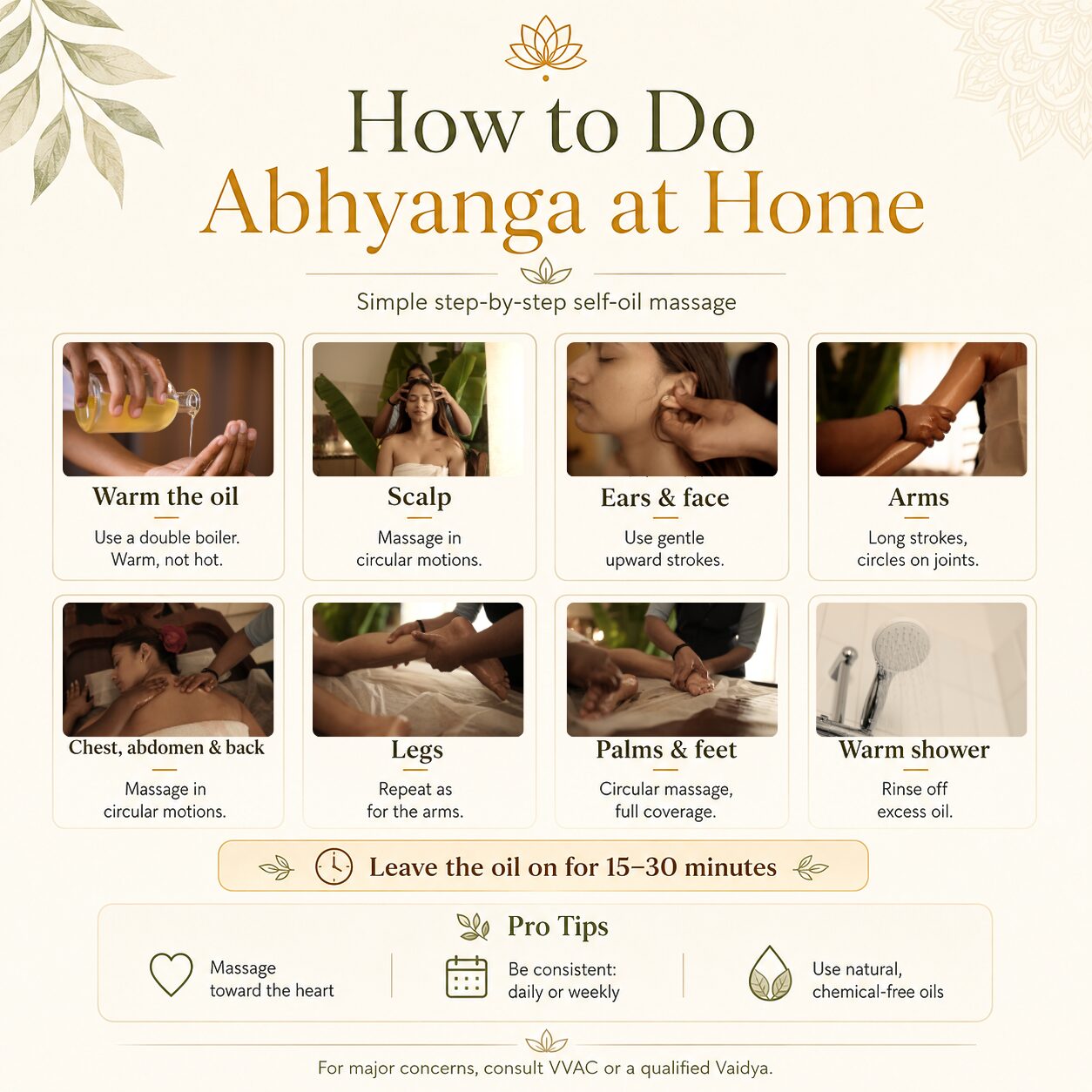
How to Do Abhyanga at Home (Step-by-Step Guide)
Abhyanga is a therapeutic process. But you can perform it at home as part of your daily routine. Ayurveda also mentions it as part of your daily routine. This is only recommended if you are doing it to maintain your health or address a minor state of disease.
For major concerns, it is advised to visit us at VVAC for proper healing guidance or consult a nearby Vaidya.
Step 1: Heat the Oil using a double-boiler method.
The oil should be at an optimum temperature – neither too hot nor too cold.
Step 2: Start doing it first on your scalp. Massage your head gently in circular motions.
Step 3: Then massage your ears and face. Use gentle strokes in an upward direction; this helps relieve tension.
Step 4: Then comes the turn of your arms. Use long strokes along the length and circular motions on joints.
Step 5: Then repeat the process on your chest, abdomen and back. Massage these areas in circular motions.
Step 6: Then repeat the process for your legs, the same as done on the arms.
Step 7: And finally, come to your feet and palms. Massage them with circular motions, ensuring complete coverage. This relaxes your entire body.
- Leave the oil on your body for the next 15 – 30 minutes. This allows all the oil to seep into your skin and deeper tissue
Step 8: Then take a relaxing, warm shower to remove the excess oil.
Pro Tips for Maximum Results:
- Always massage towards your heart
- Be consistent (daily or weekly)
- Use natural, chemical-free oils
When is the Best Time to do Abhyanga?
- Morning – it is the best time to do Abhyangam, as it fills you with energy and nourishes your body. Ayurveda recommends doing it in the morning before taking a bath.
Morning Abhyanga → Boost energy
- Evening – if you want to get rid of day-long tiredness and want a sound sleep, then you can also perform it in the evening.
Night Abhyanga → Improve sleep
Even 2 – 3 times a week can show noticeable benefits in your energy levels.
Who Should Avoid Abhyanga?
Abhyanga is generally safe for most of us out there. But there are some situations when it should be avoided:
- If you have a fever, cold, or flu
- If you are suffering from indigestion.
- Just after having your meal
- During menstruation
- If you have any skin infection
- After heavy exercise or immediately before strenuous activity
- During pregnancy, it can be done after proper consultation
- If you are diagnosed with rheumatoid arthritis
Final Thoughts
Abhyanga, as publicized now-a-days, is not only a daily routine but is also a part of complete ayurvedic treatment. Abhyanga is a type of oleation therapy mentioned in Ayurveda. If you are aiming to treat a long-term or severe disorder, you can start with Abhyanga as a home remedy. If you are not getting the desired results, then you must get it done at VVAC by our expert therapists under the guidance of our experienced Vaidyas for fruitful results.
Frequently Asked Questions (FAQs)
- How often should I do Abhyanga? It is recommended to do it daily to maximise benefits, though 2-3 times a week is also beneficial.
- How is it different from a normal massage? Abhyanga focuses on warm, medicated oil application to move toxins and balance Doshas, whereas normal massages often focus solely on muscle relaxation.
- What should I wear during abhyanga? Wear comfortable clothing you don’t mind getting oil on, or do it before getting into the shower, naked or with minimal clothing.
Scientific Evidence supporting Abhyanga
- Pilot study investigating the effects of Ayurvedic Abhyanga massage on subjective stress experience by Annetrin Jytte Basler. J Altern Complement
https://pubmed.ncbi.nlm.nih.gov/21568717/
- AYURVEDA ABHYANGA (MASSAGE) PROCEDURE – A REVIEW by Rajendra Garg, Gopesh Mangal, and Dinesh Sharma
https://www.researchgate.net/publication/344745102_AYURVEDA_ABHYANGA_MASSAGE_PROCEDURE_-_A_REVIEW
- A conceptual study on mode of action of Abhyanga by Samata, Shaila Borannavar, and Ananta S. Desai
https://jaims.in/jaims/article/view/1432
- CRITICAL STUDY OF ABHYANGA W.S.R. TO COSMETIC EFFECT: A REVIEW by Priyanka Bangre and Archana Belge
- A REVIEW ON ROLE OF ABHYANGA (MASSAGE)FOR OSTEOARTHRITIS IN GERIATRICS by Ved Prakash Gupta and Mandavi Gupta
https://ijaar.in/index.php/journal/article/view/1156
Start Your Abhyanga Journey Today.
Experience deep relaxation and rejuvenation with expert Ayurvedic care. Visit VVAC for the best Abhyanga treatment.