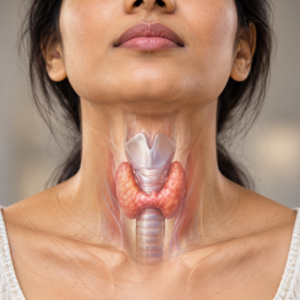
Ayurveda is one of the oldest and most honoured medical systems in the world. It is built on in-depth knowledge of natural healing and an understanding of the human body. Ayurveda remains relevant in modern times because it is grounded in the elements of nature.
If we cut down the word “Ayurveda,” it comes from the two following words.
“Ayu” means life, and “Veda” means knowledge.
Ayurveda treats ailments ranging from acute to chronic and helps us understand our bodies on our own. The best part of Ayurveda is that it treats each body as unique, with a different Prakriti (Nature). Additionally, it focuses on balancing the body, mind, and soul.
Ayurveda does not suppress the symptoms. It treats the diseases by correcting the root cause of the health concern. People view Ayurveda as spiritual or religious. In reality, it has a logical, scientific, and practical approach.
Ancient traditions hold that Ayurvedic wisdom originated with Lord Brahma, the creator of the world. Acharya Charaka organized, revolutionized, and spread Ayurvedic knowledge. Today, he is called the “Father of Ayurveda.”
Two critical schools of thought in Ayurveda are Navya and Vaisheshika. That means the following –
- Navya: It focuses on reasoning and a logical approach in Ayurveda
- Vaisheshika: It studied ailment, and its relation to nature
Together, they made Ayurveda scientific and structured at that time. Even today, several gaps remain in our understanding of Ayurveda. It limits its global spread due to language barriers, a lack of information, and other factors.
But understanding its principles, history, and strengths, we can carry forward the legacy of Ayurvedic wisdom.
What Role Do the Vedas Play in Ayurveda?
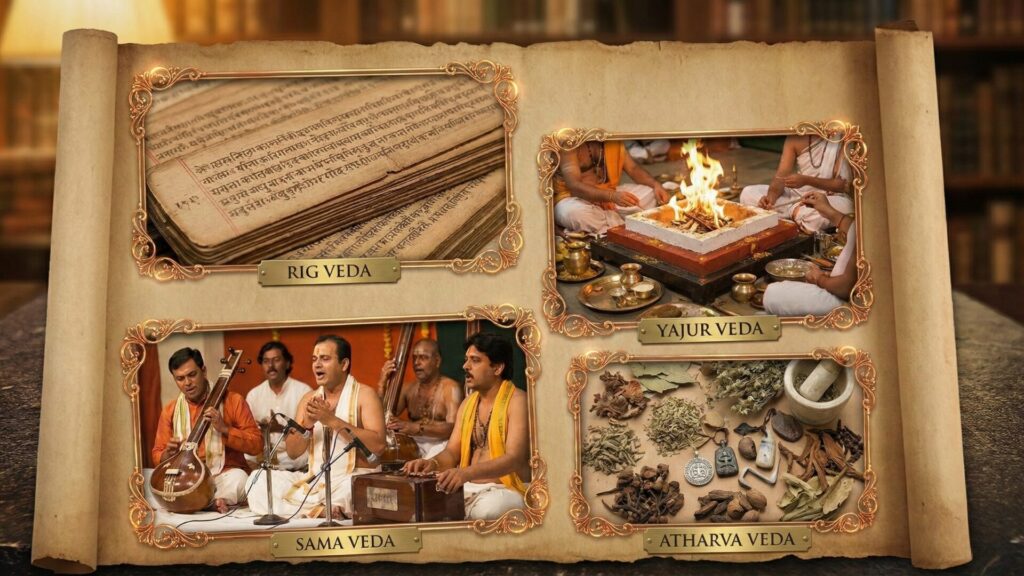
The ancient Vedas are India’s oldest books of knowledge. These classical texts discussed rituals, health, disease, and their treatment. This is where Ayurveda comes from.
- The Rig Veda mentions 67 plants with medicinal properties. It has many hymns that are about health and long life.
- Which Veda is Related to Ayurveda? The answer is “The Atharva Veda.” It covers diseases, hygiene, herbs, and the initial phases of surgery.
- The Yajur Veda and Sama Veda say that only a disciplined life can help in finding balance in your life.
To follow the chronology, Ayurveda has come from Lord Indra. Before him, Lord Brahma birthed this wisdom. Also, ancient sages like Atreya received and spread it.
Today, Acharya Charaka, the “Father of Ayurveda,” edited and refined the knowledge. He authored the Charak Samhita, which details medicine. The Sushruta Samhita was about surgery.
Later, these texts changed Ayurveda from a thought into a practical medical system. Soon, Ayurvedic texts became so important that they were translated into many languages. Such as Greek, Arabic, Chinese, Persian, and more. It has become so important that Ayurvedic physicians still study these ancient texts.
What are the Types of Doshas?
In Ayurveda, Tridoshas control every physical and mental function in the body. Let’s know each dosha individually.
- Vata (Air + Space): Vata controls movement in the body. It includes nerve signals, blood flow, tissue breakdown, cell transport, and waste removal. Dryness and irregular habits aggravate Vata dosha in the body.
- Pitta (Fire + Water): Pitta manages digestion, the metabolic system, body heat, thirst, appetite, and even vision. Also, it controls chemical changes in the body. Heat and spicy foods raise Pitta.
- Kapha (Earth + Water): Kapha builds strength, stability, and immunity levels. Additionally, it lubricates the joints and keeps tissues well-nourished. It supports tissue growth, too. Consuming sweet and fried foods increases Kapha dosha.
Health exists only when all three doshas stay in balance. A poor diet, an unhealthy lifestyle, stress, or seasonal disturbances disrupt the balance of the three doshas. As soon as there is an imbalance in tridosha, diseases begin.
Ayurveda follows one healing rule: “Similar qualities increase each other, and opposite qualities restore balance.” For instance, consuming foods with cooling properties calms excess heat in a Pitta-type body.
Ayurveda restores health by correcting dosha imbalances to avoid:
- Weakened dosha
- Toxins build up
- Beginning of the disease
What are the 5 Elements the Human Body is Made of?
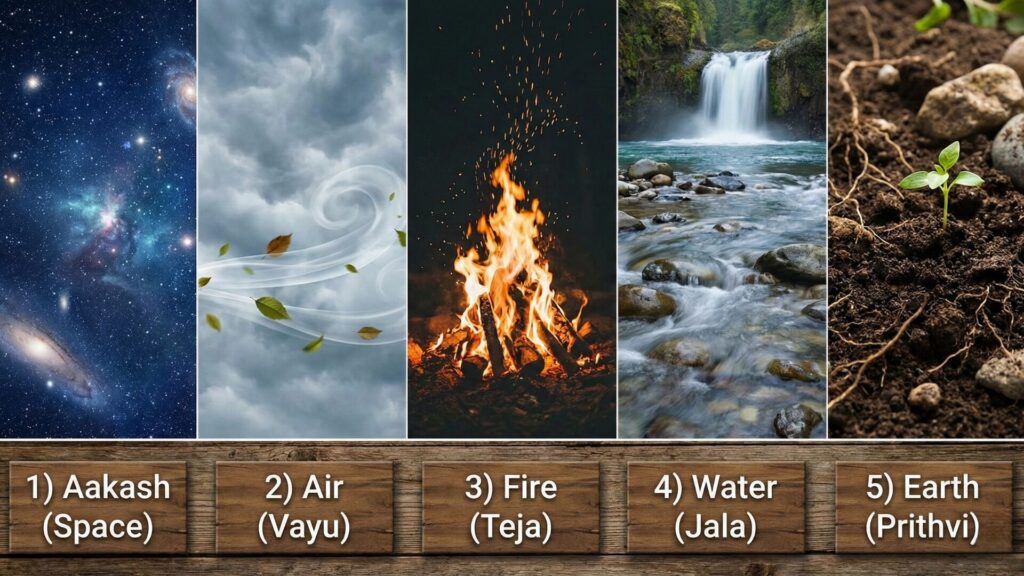
Ayurveda explains life using simple natural laws. It says both the universe and the human body are made from five basic elements, called Pancha Mahabhootas.
1) Aakash (Space): Space means emptiness and openness. It forms channels, pores, and cavities in the body. Such as the mouth, lungs, blood vessels, intestines, and others. Think of a room. Without space, you cannot move around or place furniture. In the same way, your body needs space for air to enter, food to move, and signals to travel.
2) Air (Vayu): Air represents motion and flow. It controls breathing, circulation, nerve signals, and waste removal. In your body, air keeps thoughts moving, food digesting, and more.
3) Fire (Teja): Raw food digests only because of fire in the body. The body uses inner fire to turn food into energy. Besides digestion, it produces energy, maintains body temperature, and supports vision and intelligence.
4) Water (Jala): Water represents fluidity. Just like oil improves and eases the functioning of a machine, water lubricates internally. It keeps skin soft, prevents dryness, allows smooth movement, and more.
5) Earth (Prithvi): Earth means stability and structure. If there is no foundation of a house, it will collapse. The element of earth gives weight, determination, and stamina. So, it forms bones, muscles, tissues, and elements that give physical strength.
How Does Ayurveda Understand the Human Body?
Ayurveda looks at the human body as a whole. Ayurvedic treatment doesn’t treat an issue separately. Everything in the body functions together. Also, health depends on balance. When there is an imbalance in the body, diseases crop up.
Ayurveda explains the body through the following core systems:
- Doshas: Control bodily functions
- Dhatus: Build and nourish the body
- Malas: Remove waste from the body
- Agni: Digestive fire and metabolic rate
What Are the Seven Types of Dhatus (Body Tissues)?
Dhatus are the tissues that form and sustain the body. When the dhatus are healthy, the body remains strong. Also, dhatus are weak; they weaken energy and immunity. There are seven types of dhatus in the body. Each dhatu has a specific purpose and feeds and supports the next.
| 7 Types of Dhatus | It’s Function |
| Rasa | Fluids in the body that nourish the body |
| Rakta | Rakta, also called blood, carries oxygen and nutrients to every cell |
| Mamsa | It forms the muscles that give structure to the body |
| Meda | Fatty tissues make the outer layer that protects our organs |
| Asthi | It includes the bones |
| Majja | Marrow supports nerves and bones |
| Shukra | Reproductive tissues are responsible for energy |
What are the Three Malas in Ayurveda?
A living body creates, builds, breaks, and eliminates, too. These pro-life activities happen every day. Similarly, our body creates waste every day. Ayurveda refers to these wastes as Malas in various forms.
- Stool (Purisha)
- Urine (Mutra)
- Sweat (Sweda)
Waste elimination is an essential process of the body. So proper elimination keeps the body clean, calm, and healthy. Poor elimination leads to diseases such as constipation, diarrhea, urinary infections, skin problems, joint pain, respiratory issues, and others.
What is Agni in Ayurveda?
Agni, fire, means digestive fire, which controls digestion, metabolism, and energy. In Ayurveda, there are 13 types of Agni. Jatharagni locates in the stomach, which is the most important Agni.
Strong agni is a sign of a healthy body with good digestion, clear energy, and strong immunity. Weak agni produces a sticky substance called Ama (toxins). And ama blocks the channels and starts diseases.
What are the Five Steps of Panchakarma?
Panchakarma in Ayurveda means five cleansing actions. It removes deep-seated and stored amas (toxins) from the body. Classical Panchakarma is not a quick fix. It cleans the body from the cellular level, which restores balance.
The Three Stages of Panchakarma
Panchakarma treatment always happens in three steps:
- Preparation (Poorva Karma): Ayurvedic doctors prepare the body to enhance the effectiveness of treatment. They use medicated oils and ghee for internal and external oiling. Further, they use Swedana (sweating therapy) to loosen the toxins for expulsion.
- Main Treatment (Pradhana Karma): This is the actual detox stage in the Panchakarma treatment. Toxins are removed in this stage. Doctors use personalised therapies to detoxify.
- Recovery (Paschat Karma): The body rests and rebuilds. Hence, a light diet and disciplined routine help the digestion process.
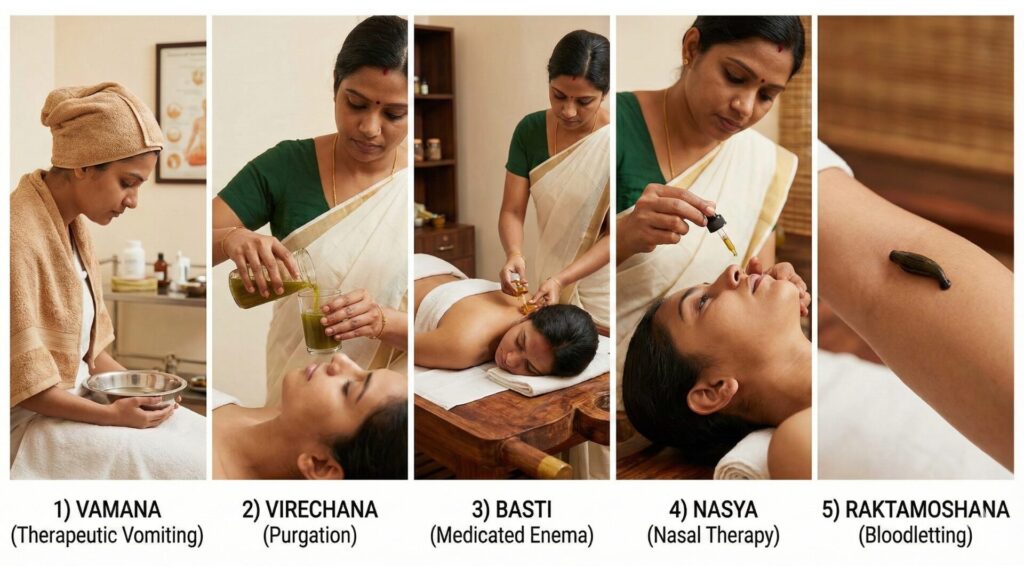
Let’s discuss the five Panchakarma therapies that cleanse the body. Note: Not everybody needs all five therapies.
1) Vamana: This step in Panchakarma involves controlled therapeutic vomiting. It removes excess Kapha and chest congestion.
2) Virechana: This planned purgation clears excess Pitta and toxins from the liver and gut.
3) Basti: Medicated enemas that balance Vata dosha and clean the colon.
4) Nasya: This nasal medicine therapy cleans the head, sinuses, and sense organs.
5) Raktamoshana: It helps with skin diseases and toxin buildup in the blood through medicated leeches.
What are the Eight Branches of Ayurveda?
Ayurveda sums up the entire human body. The Ashtanga Ayurveda has eight medical branches. They are as follows –
- Kayachikitsa (Internal medicine)
- Shalya (Surgery)
- Shalakya (ENT and eye care)
- Agada Tantra (Toxicology)
- Bhootavidya (Mental and psychological care)
- Kaumar Bhritya (Child care and pediatrics)
- Rasayana (Rejuvenation and healthy aging)
- Vajikarana (Fertility and reproductive health)
The Golden Age of Ayurvedic Medicine
The golden period of Ayurvedic medicine is between 800 BCE and 1000 CE. It was the era when the Charak Samhita and Sushruta Samhita came into light. Basically, Ayurveda entered a period of remarkable growth and refinement. Also during this era:
- Medical texts were compiled
- Knowledge of anatomy, herbs, diagnosis, and treatment expansion
- Ayurveda traveled from India to other countries. It influenced people from different nationalities, such as Greeks, Chinese, Persians, and more.
Ayurveda’s Impact on the Modern World
Ayurveda is no longer a traditional or limited practice confined to texts. Today, health seekers in India and around the world trust the medical field of Ayurveda. As per the study conducted by the National Sample Survey Office (NSSO) between July 2022 and June 2023.
This study is the first exclusive all-India survey focused on “Ayush.” It includes Ayurveda, yoga, naturopathy, Unani, Siddha, Sowa-Rigpa, and homeopathy.
Study’s overview and methodology: The survey was a part of the 79th round of the National Sample Survey (NSS) and covered 1,81,298 Indian households.
Results
| Ayurvedic System of Medicine | Urban Households (77,103) | Rural Households (104,195) |
| Use of Ayurveda for Treatment | 45.5% | 40.5% |
| Average Expense on Ayurveda Per-person expenditure over one year | Rs. 499 | Rs. 394 |
Health seekers are turning to Ayurveda and other traditional forms of medicine for prevention and cure. Gradually, Ayurvedic lifestyle and treatment are becoming their “first choice.”
A new field, “Ayurgenomics,” links different Ayurvedic body types with DNA patterns. It means that Ayurveda therapies must be personalised. Today, artificial intelligence has joined hands with Ayurveda, which helps with –
- Prakriti digital analysis
- Personalised diet and lifestyle plans
- Efficient reporting and arrangement of classical texts for reference
- Helping doctors with case histories and analysis
The introduction of artificial intelligence has become beneficial. However, it cannot fully replace the expertise of Ayurvedic physicians. Ayurveda has come a long way and is going to boom in the coming years.