What is Ayurveda? A Complete Guide to the Ancient Science of Life
Ayurveda is one of the world’s oldest and most comprehensive systems of health and medicine. It originated in India between 3000 and 5000 years ago. Ayurveda forms a science of optimal living, guiding individuals to align with their unique body constitution and the natural world.
The word “Ayurveda” comes from two Sanskrit roots:
- Āyus, meaning life (Quality of life)
- Veda, meaning knowledge or science
The term “Ayurveda” thus translates to “the science of life.” Ayurveda includes health maintenance, disease prevention, treatment, longevity, mental clarity, and spiritual well-being. It also focuses on enhancing Ojas and vitality. This comprehensive framework establishes the foundation for its core principles.
The Core of Ayurveda: Prevention Before Cure
Acharya Sushruta defines Swastha (Health) in the Sushruta Samhita (15.38). How? Read the following shloka:
समदोषः समाग्निश्च समधातु मलक्रियाः।
प्रसन्नात्मेन्द्रियमनाः स्वस्थः इत्यभिधीयते।।
This shloka says, “A person is healthy when their doshas balance, digestion works well, and waste removal is normal. Also, the mind, senses, and soul are calm and clear.”
In Ayurveda, “Swastha” does not only mean being free from any ailment. The word itself means to establish one’s own constitutional balance. That is always influenced by diet, lifestyle, environment, and mental state.
So, true health is present only when the body functions in an efficient manner. Individual experiences calm the mind, clear the senses, and provide stability to function.
Purpose of Ayurveda
The Charaka Samhita, a key ancient text, explains the main purpose of Ayurveda. It says Ayurveda has two main goals.
- Swasthasya Swasthya Rakshanam – It means that Ayurveda preserves and maintains a person’s health.
- Aturasya Vikara Prashamanam – To treat the disease from the roots and restore balance in the sick.
Thus, Ayurveda prioritizes the prevention of diseases and the maintenance of balance.
The Philosophical Foundation: Pancha Mahabhutas
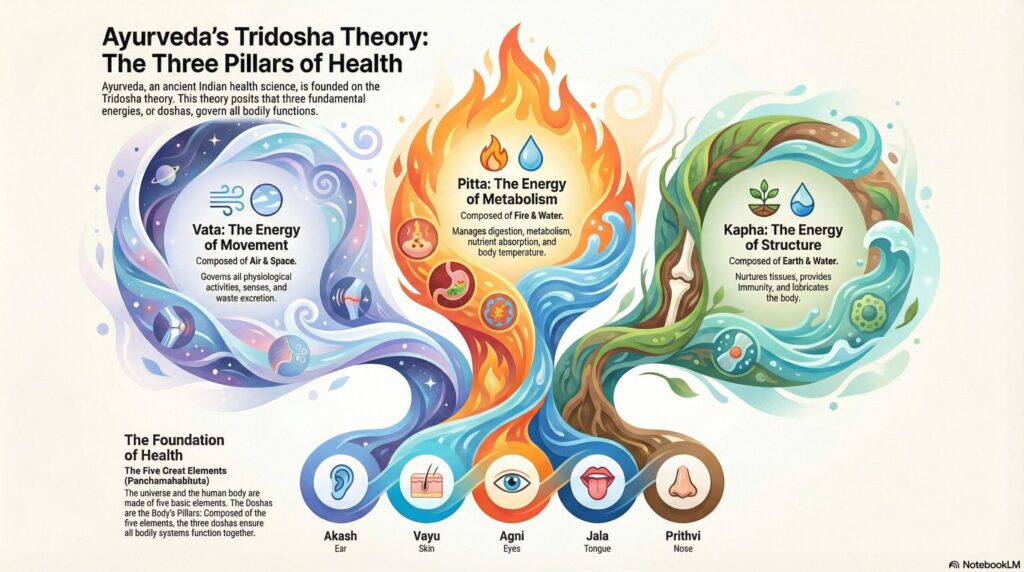
Ayurveda describes body function through the concept of Pancha Mahabhutas. Pancha Mahabhutas, or the five fundamental elements, represent physical substances and functional principles.
Together, they govern the transformation and interaction of matter. So, everything in this universe has these five elements in different proportions.
Akasha (Space)
The Akasha element signifies space, openness, and emptiness. Within the human body, it forms channels and cavities. For example, the mouth, nostrils, blood vessels, gastrointestinal tract, and around the cells.
By providing the necessary space for organs to exist, expand, and function, Akasha aids in movement and communication.
Vayu (Air)
Vayu handles movement and activity in the body. It controls things like breathing, nerve signals, muscle movement, and blood flow. Also, how nutrients and waste move. When Vayu balances, all these actions happen in a smooth manner.
Agni (Fire)
Agni is responsible for digestion, metabolism, enzyme activity, cell function, and body temperature. It turns food into energy, tissues, and waste. If Agni is weak, digestion is poor, and toxins build up, then health problems arise.
Jala (Water)
Jala gives fluidity and nourishment. It keeps tissues moist, lubricates joints, and supports fluids. (Some of the fluids are plasma, lymph, saliva, digestive juices, and blood.) When Jala balances, the body works well. If not, it can cause dehydration, swelling, or too much mucus.
Prithvi (Earth)
Prithvi stands for solidity and structure. It makes up bones, muscles, fat, organs, and body mass. Prithvi gives strength, stability, and endurance. Too little leads to weakness, while too much causes heaviness, congestion, and stiffness.
Below is a table about the Mahabhutas’ clean properties. It also includes their corresponding sense organs.
| Mahabhuta | Core Properties (Guna & Function) | Associated Sense Organ (Indriya) |
| Akasha (Space) | Openness, emptiness, lightness, sound conduction | Ear (Shrotra) |
| Vayu (Air) | Movement, dryness, lightness, touch sensation | Skin (Tvak) |
| Agni (Fire) | Heat, transformation, digestion, vision, metabolism | Eyes (Chakshu) |
| Jala (Water) | Fluidity, cohesion, lubrication, taste, softness | Tongue (Jihva) |
| Prithvi (Earth) | Solidity, stability, heaviness, structure, smell | Nose (Ghrana) |
According to Ayurveda, humans are a living combination of the five elements. These elements interact and adapt to maintain balance. Ailments arise due to disturbed balance, altering structure, movement, metabolism, or fluid regulation.
What Are Three Types of Doshas?
There is a research paper, “The Tridosha Theory According to Ayurveda,” published in ResearchGate. It highlights the concept of Tridosha. The Ayurvedic understanding of health and illness depends on the types of dosha.
At the heart of this idea are the three doshas: Vata, Pitta, and Kapha. These are not illnesses or problems but natural energies that keep us alive.
The term “Tridosha” comes from two Sanskrit words:
“Tri” means three, and “Dosha” means a factor that can disturb balance.
The word “dosha” is often considered a “pollutant.” But, research clarifies that doshas are harmful only when disturbed.
Types of Doshas: What is the meaning of Tridoshic?
Vata Dosha (Air + Space)
Vata is the principle of movement. It controls breathing, circulation, nerve impulses, digestion, and elimination. This study highlights Vata’s roles as the “Director” of the mind and senses. Furthermore, without Vata, nothing in the body moves, thinks, or communicates.
Pitta Dosha (Fire + Water)
Pitta stands for transformation. It controls digestion, metabolism, body temperature, and chemical reactions. Pitta turns food into energy, nutrients into tissues, and sensory input into understanding.
Kapha Dosha (Earth + Water)
Kapha provides structure, strength, and stability. It lubricates joints, nourishes tissues, and builds immunity. The research identifies Kapha as the force responsible for some factors. The factors are growth, endurance, and emotional calmness.
Sun, Moon, and Wind Analogy: Besides the three doshas, their alignment with natural forces maintains health.
- Kapha nourishes and stabilizes the Moon.
- Pitta transforms and regulates the Sun.
- Vata distributes and mobilizes the wind.
How Ayurveda Defines Health
The research says health is more than “not being sick.” A healthy person:
- The three doshas remain in harmony.
- The seven body tissues (Dhatus) are well-nourished.
- Smooth elimination of waste products
Additionally, the causes of the disease are many. It ranges from poor daily habits, wrong or incompatible diets to emotional baggage. Disturbed environmental balance also becomes a cause of ailments.
Important Observations from the Study
Sub-Doshas and Precision Healing: Each dosha is further divided into five sub-doshas. Sub-doshas depend on specific locations and functions. For example, Prana Vata governs breathing and mental clarity.
Also, Apana Vata controls elimination and reproductive health. This allows Ayurveda to treat conditions with remarkable precision.
Mind-Body Unity: The study emphasizes that mental and physical health are inseparable. Emotional stress, fear, or anger can disturb doshas as much as poor diet or lifestyle. Physical healing is essential for a calm, strong, and sattvic mental health.
Certain yoga and breathing exercises help keep each dosha balanced. For example, Surya Namaskara boosts Kapha, and Sheetali Pranayama cools Pitta. Also, grounding poses with slow breathing help balance Vata.
What is the difference between Vikriti and Prakriti?
Everyone is born with a set body type called Prakriti, decided at conception. Prakriti shapes your body build, metabolism, and emotions. Also, how likely you are to get certain illnesses.
Prakriti remains constant throughout life. Vikriti arises from imbalances in diet, lifestyle, stress, seasons, or aging. Ayurvedic treatment always aims to restore the balance to one’s original Prakriti.
What is the concept of Agni and Ama?
Agni, or digestive and metabolic power, is a key idea in Ayurveda. When Agni balances, it leads to:
- Proper digestion
- Efficient tissue nourishment
- Strong immunity
When Agni weakens, it produces Ama. Ama is a sticky, toxic, and undigested residue that blocks body channels and triggers inflammation. It initiates disease at the cellular level. This is where classical Panchakarma treatment can benefit a person to stay disease-free. But how does that happen?
Before starting any Ayurvedic treatment, a proper diagnosis is essential. This helps make sure the therapy matches each person’s unique needs.
- Nadi Pariksha (Pulse examination)
- Darshana (Visual observation)
- Sparshana (Touch and Palpation)
- Prashna (Detailed History-Taking)
Hence, these Ayurvedic diagnostic methods assess doshic imbalance, tissue strength, and digestive power. Additionally, these methods also assist in analyzing the mental state.
What are the 5 Treatments of Panchakarma?
Research titled “Ayurveda and Panchakarma: Measuring the Effects of a Holistic Health Intervention” documents an observational study. 20 females participated in the study and underwent a modified 5-day Panchakarma cleansing retreat.
This study is particularly important because it represents the first published scientific research on Panchakarma conducted in a Western setting. The result offers early evidence of how this classical Ayurvedic detox functions beyond its traditional context.
Key Insights from this Study
- Panchakarma treatment helped participants adopt and sustain healthier lifestyle behaviors.
- Participants felt more confident in managing their health using Ayurvedic practices.
- Mental and emotional benefits, such as reduced anxiety, became more noticeable over time.
- The program was safe, with only mild, temporary side effects.
- Changes included are physical, behavioral and emotional ones.
This study reflects the five phases of Panchakarma. It shows the relationship of systematic purification, rest, and rejuvenation with health. Health includes sustained physical health, emotional well-being, and mental wellness.
Panchakarma is Ayurveda’s most advanced therapeutic system. It removes deep-seated toxins and restores systemic balance.
The five main procedures are
- Vamana – therapeutic emesis for Kapha disorders
- Virechana – purgation for Pitta disorders
- Basti – medicated enema for Vata disorders
- Nasya – nasal therapy for head and neck disorders
- Raktamokshana – blood purification
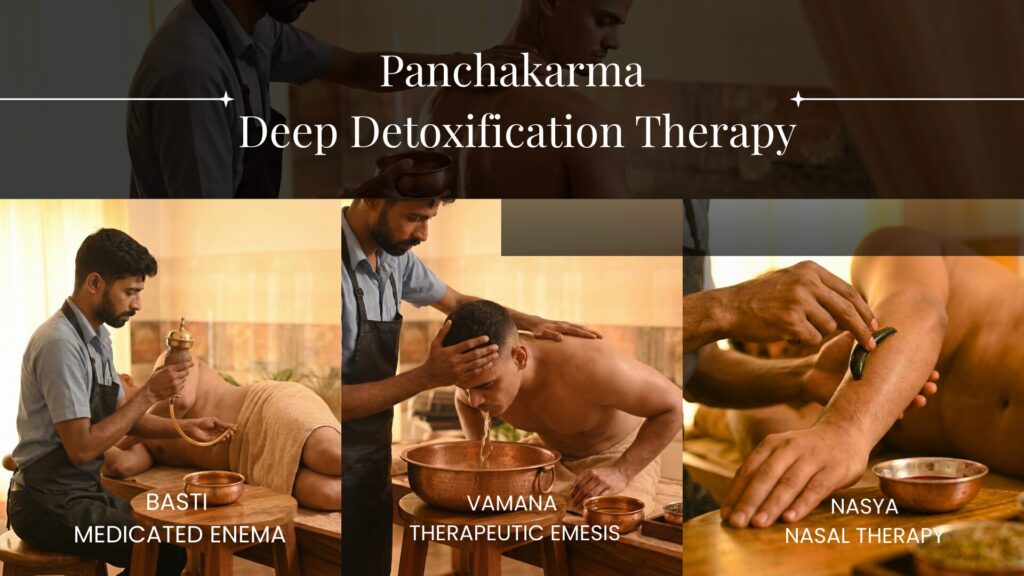
Panchakarma is always preceded by Purvakarma (preparatory therapies like Snehan and Swedan). Further, Paschatkarma (rejuvenation and diet regulation) follows the preparatory Ayurvedic treatments. Ayurveda therapy combines medicine into daily living through Dinacharya (daily routine). Others are –
Ritucharya (seasonal adaptation of diet and habits)
Ahara Vidhi (dietary rules based on digestion and dosha)
ihara (lifestyle conduct and ethical living)
Why Choose VVAC for Authentic Ayurvedic Treatment
To gain from authentic Ayurvedic treatment, choose a place with classical Ayurveda. That’s where Vaidyaratnam Vrindavan Ayurveda Chikitsalayam stands out.

- Classical Ayurvedic treatment is rooted in authentic Kerala traditions.
- Expert Ayurvedic doctors who assess your Prakriti and Vikriti
- Structured Panchakarma protocols for safe and effective healing
- Pure herbal medicines and medicated oils are freshly prepared at VVAC’s in-house Kashayapura.
- Personalised Ayurvedic treatment plans to enhance the effects of the therapy.
- VVAC is situated across 25 acres on the Shivalik hilltop, creating a perfect environment for physical and mental rejuvenation.
- Ayurvedic treatments at VVAC are either cashless or reimbursable, as VVAC is empaneled with CAPF, CGHS, & Haryana government.
So, begin your journey with Ayurveda at VVAC (India’s best Ayurvedic hospital) by filling out your personal details below.
FAQ’s About Ayurvedic Treatment
1. What is Panchakarma treatment in Ayurveda?
Panchakarma is a classical Ayurvedic detoxification therapy. It removes accumulated toxins (Ama), balances doshas, and restores natural healing mechanisms.
2. Who should undergo Panchakarma therapy?
Panchakarma is suitable for people experiencing chronic stress, digestive issues, pain, fatigue, lifestyle disorders. Also, anyone seeking preventive healthcare.
3. Is Panchakarma safe for everyone?
When performed under expert Ayurvedic supervision, Panchakarma is safe. At VVAC, treatments are based on a detailed health assessment.
4. How long does Panchakarma treatment take?
Depending on your condition, Panchakarma may range from 7 to 21 days. It includes preparation, detox, and rejuvenation phases.
5. What conditions are treatable with Panchakarma?
Panchakarma is effective for several ailments. Chronic pain, arthritis, digestive disorders, stress, hormonal imbalance, skin conditions, and metabolic disorders are some.
6. What makes VVAC different from other Ayurvedic centers?
VVAC follows authentic Kerala-style Ayurveda. Vrindavan Chikitsalayam has experienced physicians, trained therapists, classical protocols, and a healing environment.
7. Are Ayurvedic medicines used at VVAC safe and natural?
Yes. VVAC uses time-tested herbal formulations. All the formulations are as per classical Ayurvedic texts under strict quality standards.
8. Will Panchakarma help with stress and burnout?
Yes, Panchakarma calms the nervous system, balances Vata dosha, and improves mental clarity. Panchakarma treatment develops emotional resilience, too.
9. Do I need to follow a special diet during treatment?
Yes. A personalized Ayurvedic diet is an essential part of Panchakarma. At VVAC, our doctors prescribe meals based on your digestion and dosha balance.
10. Who is the Father of Ayurveda?
Acharya Charaka, the father of Ayurveda established internal medicine (Kayachikitsa). He also defined clinical diagnosis, emphasised disease caustion, and laid down medical ethics.